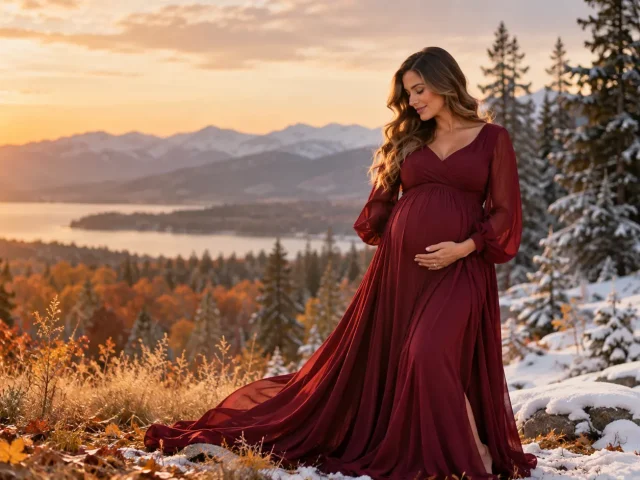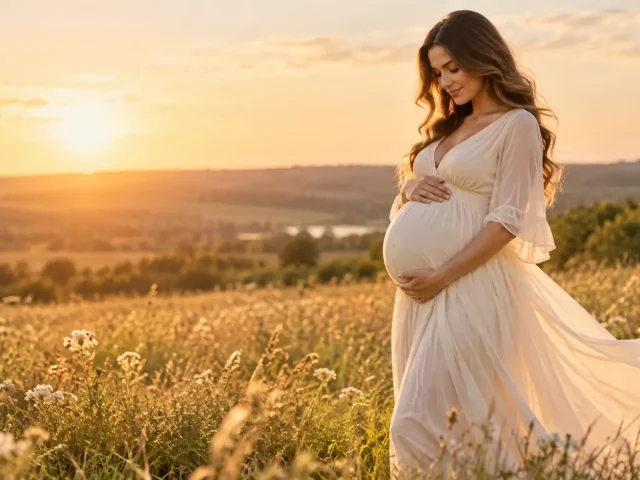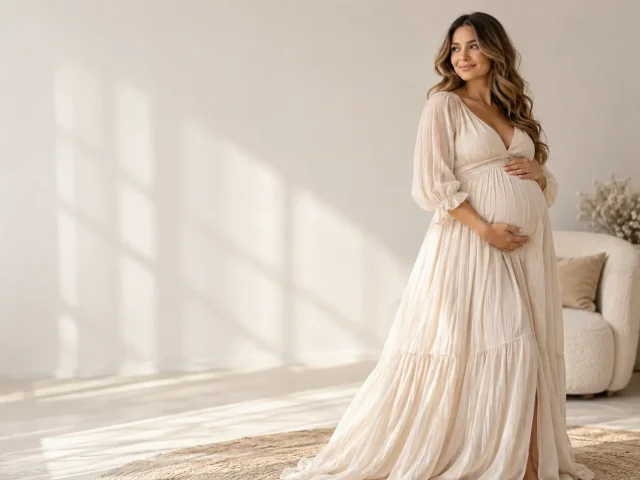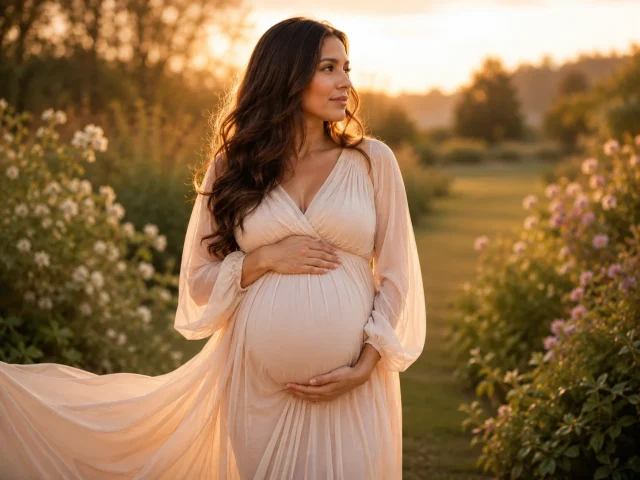
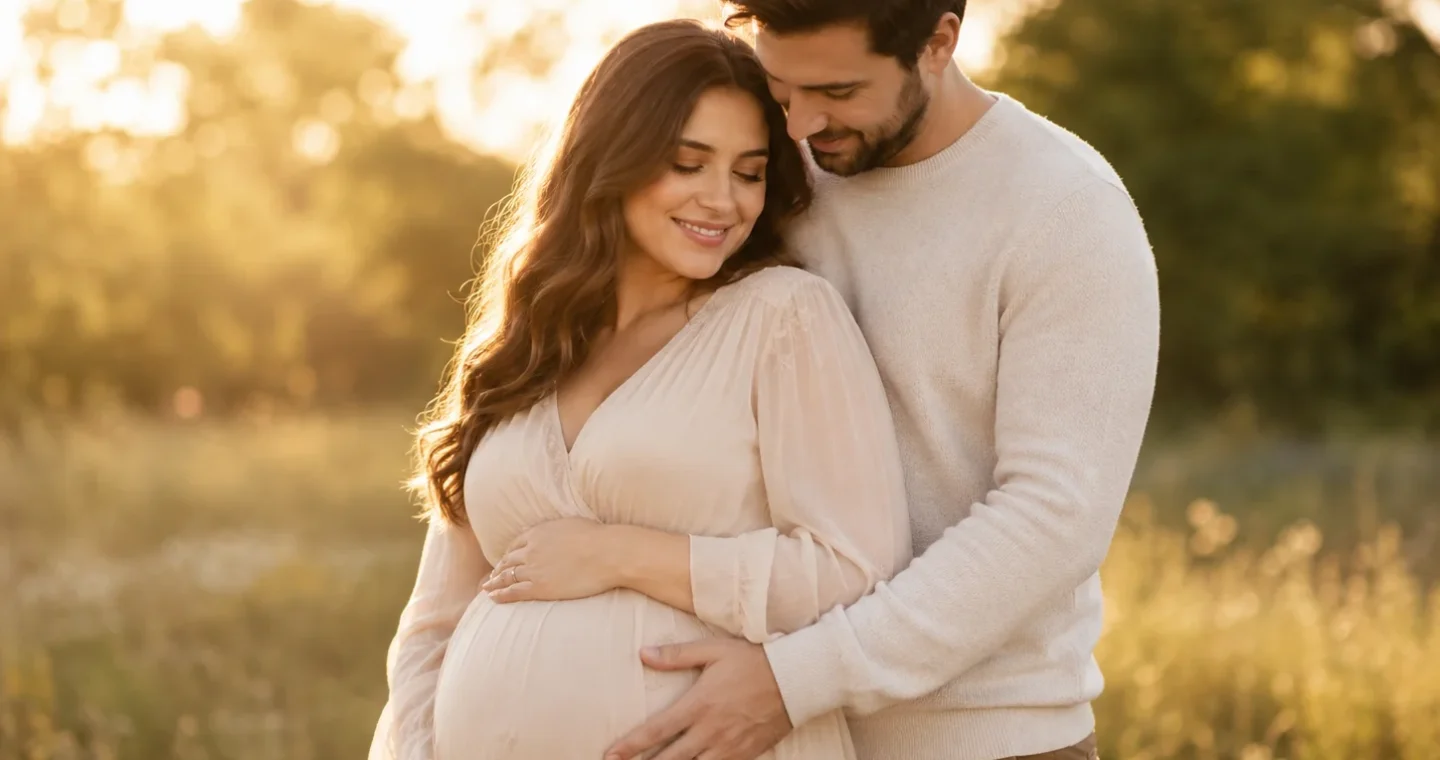
Couple maternity photos are about more than documenting a growing baby bump. They capture the relationship between two people as they prepare to become parents and preserve the quiet, affectionate moments that often define this stage of pregnancy.
However, posing together does not always feel natural. One partner may be comfortable in front of the camera while the other feels unsure about where to stand, what to do with their hands or how to smile without looking forced. Even naturally affectionate couples can become stiff when someone points a camera at them.
The good news is that meaningful maternity photographs rarely require complicated poses. Simple actions—walking together, holding hands, looking at the baby bump or sharing a quiet moment—often create the most genuine images.
The best couple maternity photos feel connected rather than carefully staged. A hand resting gently above the bump, a soft forehead touch or a partner standing slightly behind the expecting parent can communicate affection without making the pose feel overly dramatic.
In this guide, you will discover 25 couple maternity photoshoot ideas, including natural standing poses, walking photographs, romantic close-ups, seated portraits and creative ways to document your relationship. You will also find practical guidance for hand placement, outfit coordination, choosing a location and helping a camera-shy partner feel more comfortable.
For additional solo poses, maternity outfits, creative concepts and location inspiration, explore our complete guide to 51 beautiful pregnancy photoshoot ideas.
Quick Couple Maternity Photoshoot Planner
Before choosing individual poses, decide how you want your maternity photographs to feel. A clear mood will make it easier to choose the right location, clothing and posing style for your session.
| Desired Mood | Best Pose Type | Best Location | Outfit Direction | Helpful Prompt |
|---|---|---|---|---|
| Romantic | Forehead touches, gentle embraces and bump kisses | Garden, beach or open field at golden hour | Flowing maternity dress with soft, coordinated neutral clothing | “Stand close, close your eyes and slowly lean your foreheads together.” |
| Relaxed | Walking, holding hands and sitting together | Home, park or a familiar outdoor location | Comfortable solid colours and natural fabrics | “Walk slowly together and talk as though the camera is not here.” |
| Playful | Laughing, slow dancing and gentle dress movement | Beach, garden, city street or bright studio | Light colours, casual layers or a dress with movement | “Whisper something funny, then look at each other instead of the camera.” |
| Elegant | Side-by-side portraits and structured standing poses | Studio, hotel interior or architectural location | Fitted gown, tailored shirt and refined neutral tones | “Turn slightly towards each other and keep your hands softly connected.” |
| Intimate | Close-up embraces, hands on the bump and seated bed poses | Bedroom, nursery or softly lit studio | Simple clothing in cream, beige, white or muted colours | “Take a deep breath together and quietly look down at the baby bump.” |
| Dramatic | Silhouettes, wide landscapes and flowing-dress poses | Sunset beach, hilltop, open field or dark studio | Bold gown with a clearly defined silhouette | “Stand sideways to the light and create a clear outline around the bump.” |
You do not need to follow only one style. A complete gallery can combine relaxed walking photographs, romantic close-ups and one or two elegant portraits for variety.
Natural Standing Couple Maternity Poses
Standing poses are a useful place to begin because they work in almost every setting, from a studio or bedroom to a beach, garden or city location. The key is to avoid having both people stand completely straight and face the camera at the same angle.
Small adjustments can make a standing portrait feel much more natural. Turn the couple slightly towards each other, keep the shoulders relaxed and give each person a clear place for their hands. The expecting parent should usually remain closest to the camera so the baby bump stays visible and flattering.
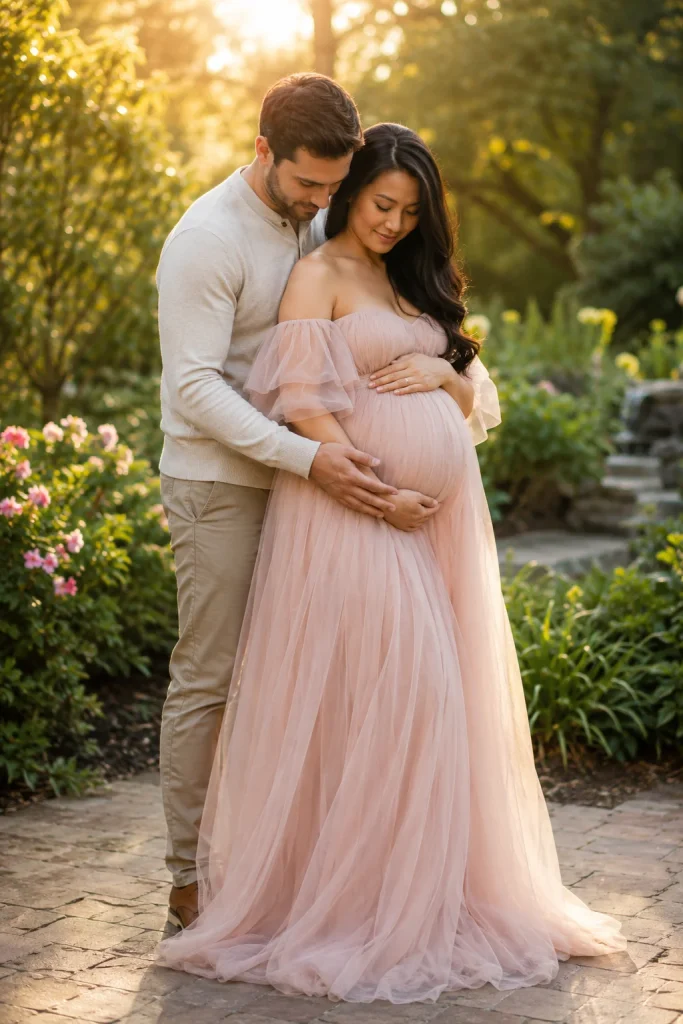
1. Partner Standing Behind With Hands on the Bump
This classic couple maternity pose creates an immediate sense of closeness and keeps the pregnancy at the centre of the photograph. The expecting parent stands slightly in front while their partner moves close behind, wrapping their arms gently around the waist or bump.
To prevent the pose from looking rigid, the partner should avoid stretching both arms tightly across the body. Instead, place one hand softly above the bump and the other underneath or around the waist. Keeping the elbows slightly bent creates a more relaxed shape.
The expecting parent can place one hand over their partner’s hand, look down at the bump or turn their face gently towards them. The couple does not need to look directly at the camera.
Practical tip: Leave a small amount of space between the arms and the body so the couple does not appear compressed. Ask both partners to relax their shoulders before taking the photograph.
Helpful photographer prompt: “Stand close together, place one hand above the bump and one below, then take a slow breath and look down at your hands.”
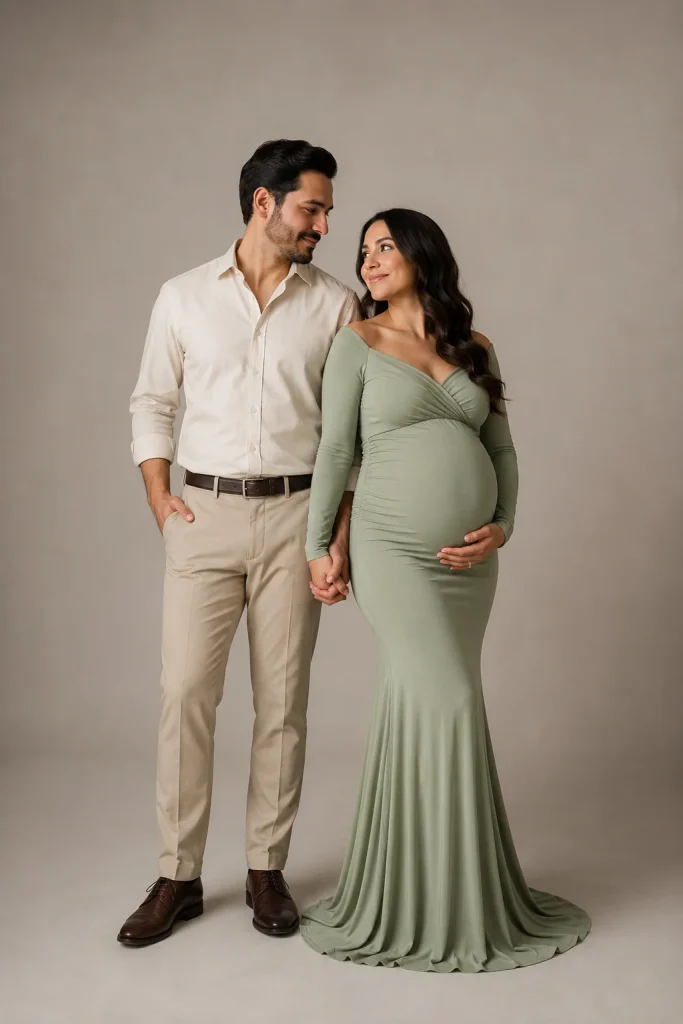
2. Standing Side by Side With Joined Hands
Standing side by side is one of the easiest options for couples who do not want an intensely romantic pose. It feels simple, familiar and comfortable while still showing the couple’s connection.
Rather than positioning both bodies flat towards the camera, ask the couple to turn slightly inwards. The expecting parent can place their free hand below the bump while the partner keeps their free hand in a pocket, around the waist or resting gently behind them.
This pose works particularly well for full-length portraits because it allows the photographer to show the couple’s outfits, body language and location together.
Practical tip: Ask the couple to stand close enough for their shoulders or hips to touch. Too much space between them can make the portrait feel formal or disconnected.
Helpful photographer prompt: “Hold hands naturally, turn your shoulders slightly towards each other and look in the same direction.”
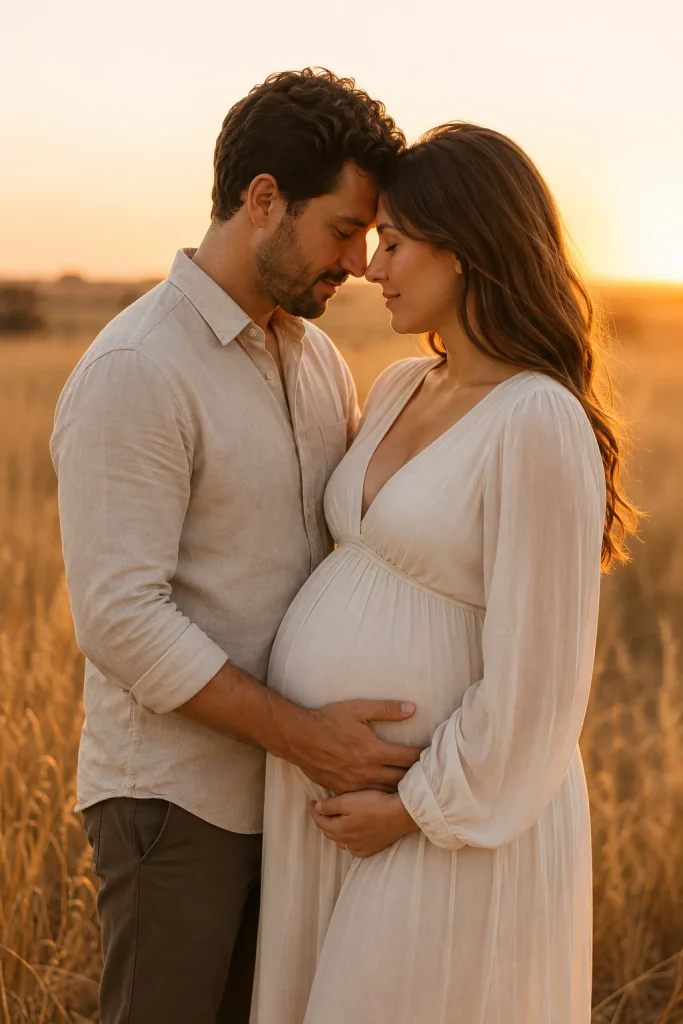
3. Forehead-to-Forehead Pose
A forehead-to-forehead pose creates intimacy without requiring a dramatic kiss or a large smile. It is especially useful when one or both partners feel uncomfortable looking directly into the camera.
The couple should stand close, angle their bodies slightly towards each other and bring their foreheads together gently. Their noses do not need to touch. One partner can place a hand around the waist while the expecting parent rests a hand on the bump.
Closed eyes often make this pose feel softer and more emotional. The photographer can capture it from the side or at a three-quarter angle so both faces remain visible.
Practical tip: Keep the chins slightly lowered to avoid creating tension in the neck. The touch should feel light rather than pressed together.
Helpful photographer prompt: “Close your eyes, lean your foreheads together softly and take one slow breath at the same time.”
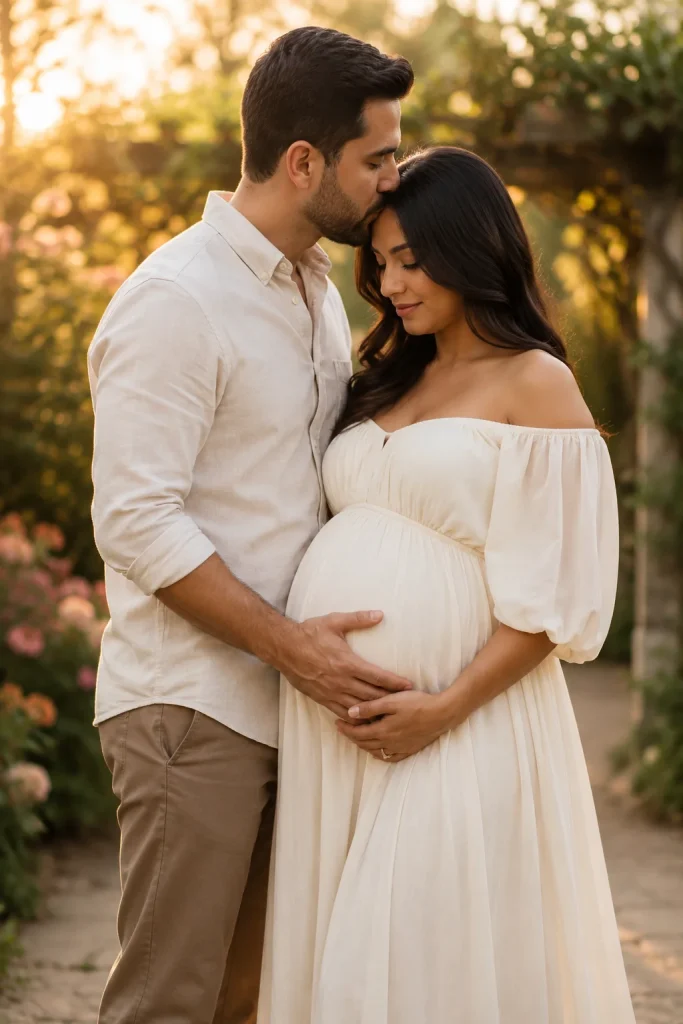
4. Partner Kissing the Forehead
A forehead kiss is a warm, protective pose that works well in both close-up and full-length photographs. It communicates affection while keeping the interaction simple and natural.
The partner can stand slightly behind or beside the expecting parent and place one hand around the waist or on the bump. The expecting parent can look down, close their eyes or smile softly rather than facing the camera.
This pose is particularly flattering when photographed from a slight side angle because the baby bump, the kiss and both profiles can remain visible in the frame.
Practical tip: Ask the partner to kiss the forehead slowly and pause for a moment. This gives the photographer enough time to capture a relaxed expression rather than a rushed movement.
Helpful photographer prompt: “Move close, hold the bump gently and give a soft forehead kiss while your partner looks down.”
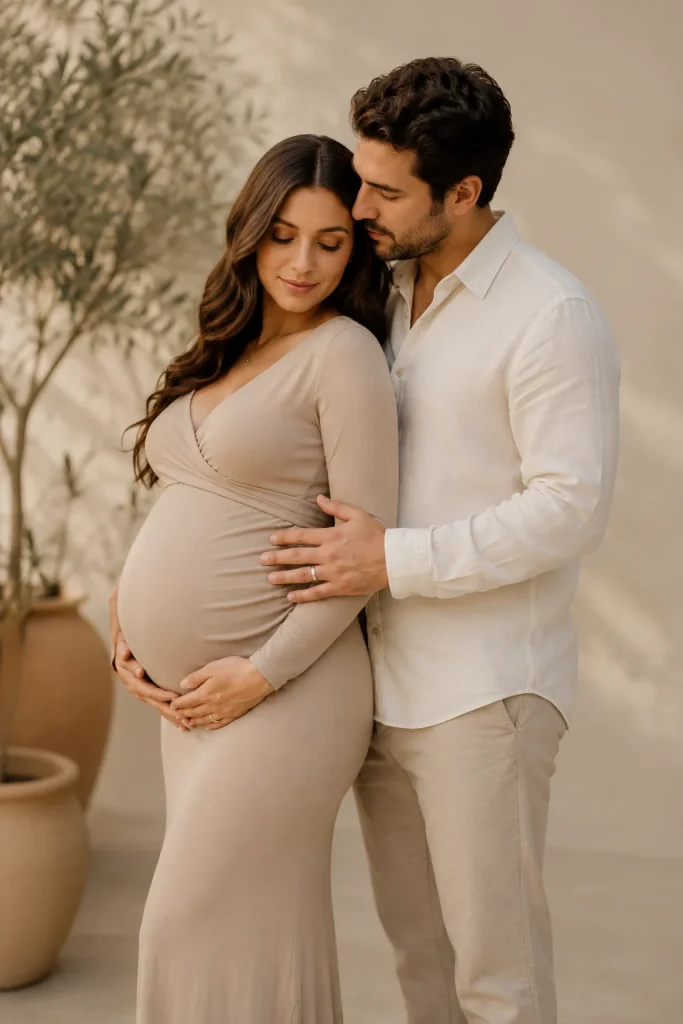
5. Both Partners Looking at the Baby Bump
This pose directs attention towards the pregnancy and often creates one of the most meaningful photographs in the gallery. The couple can stand side by side, face each other slightly or use a gentle rear embrace.
Both partners should look down naturally rather than sharply lowering their heads. Their hands can rest above and below the bump, but they do not need to place all four hands in exactly the same area.
Allowing each person’s hands to occupy a slightly different position creates a cleaner and less crowded composition. For example, the expecting parent can place one hand underneath the bump while their partner rests one hand above it and another around the waist.
Practical tip: Give the couple a few seconds to settle into the position before taking the picture. The first expression may look posed, while the following moments often feel softer.
Helpful photographer prompt: “Look down at the baby together, relax your hands and stay there for a few quiet seconds.”
6. Partner Standing Slightly Behind and to the Side
Positioning the partner behind and to the side adds depth to the photograph and prevents both people from appearing flat against the background. It is a strong option for elegant studio portraits, outdoor landscapes and fitted maternity dresses.
The expecting parent should stand closest to the camera with their body turned slightly sideways so the bump is clearly defined. The partner can stand one step behind, placing a hand around the waist, on the shoulder or gently against the upper part of the bump.
The couple can look at the camera, look at each other or direct their attention towards the bump. This pose is easy to adjust, making it useful for creating several variations without moving to a completely different setup.
Practical tip: Keep both faces on slightly different levels or angles so one person does not disappear behind the other.
Helpful photographer prompt: “Stand one step behind, turn towards your partner and bring your faces close without hiding either profile.”
During a standing series, try photographing each pose from several distances. A full-length image shows the setting and outfits, a medium portrait highlights the couple’s connection and a close-up captures hands, expressions and smaller details.
Walking and Movement-Based Couple Maternity Photos
Movement-based poses are especially helpful for couples who feel uncomfortable standing still in front of the camera. Walking, swaying and turning give both partners something natural to do, which often leads to more relaxed expressions and genuine interaction.
These poses also add variety to a maternity gallery. Instead of every photograph feeling formal, movement creates a softer lifestyle quality and helps the session feel more like a shared experience than a series of instructions.
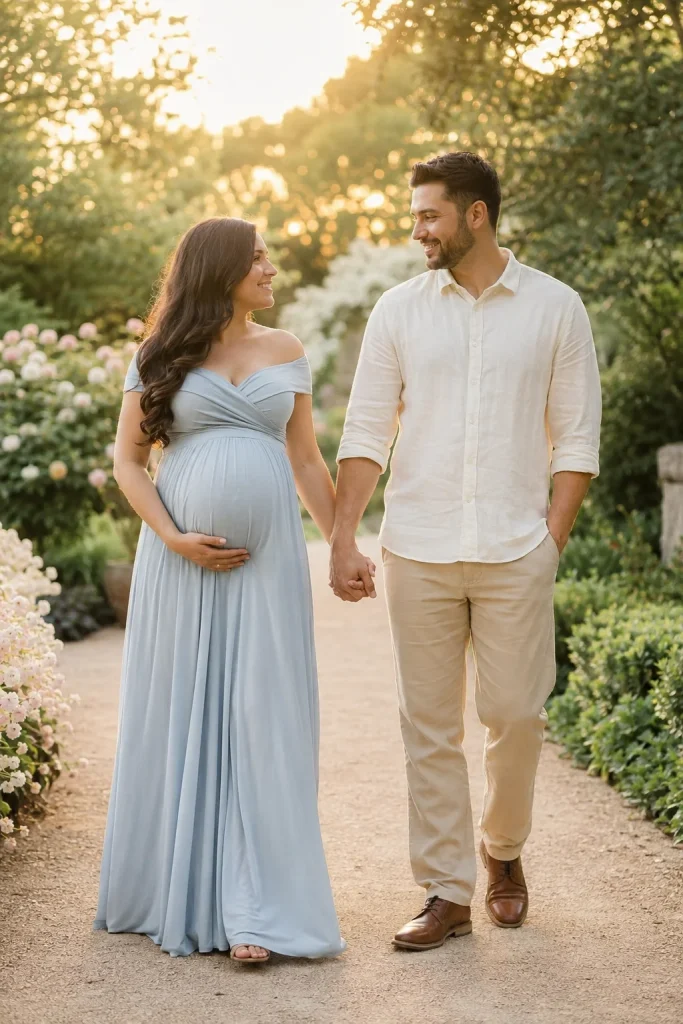
7. Walking Hand in Hand
Walking hand in hand is one of the easiest and most natural couple maternity photoshoot ideas. It works particularly well in parks, open fields, beaches, gardens and quiet city streets.
The couple should walk slowly rather than taking long or hurried steps. The expecting parent can keep one hand connected with their partner while placing the other hand underneath the bump. They can look at each other, look ahead or glance down at the baby bump as they walk.
The photographer should leave enough distance in front of the couple so they have room to move naturally. Taking several photographs in sequence makes it easier to capture a balanced step, relaxed hands and an authentic expression.
Practical tip: Ask the couple to walk more slowly than usual. Gentle movement creates cleaner posture and gives the photographer more control over the composition.
Helpful photographer prompt: “Walk towards me slowly, keep holding hands and look at each other instead of the camera.”
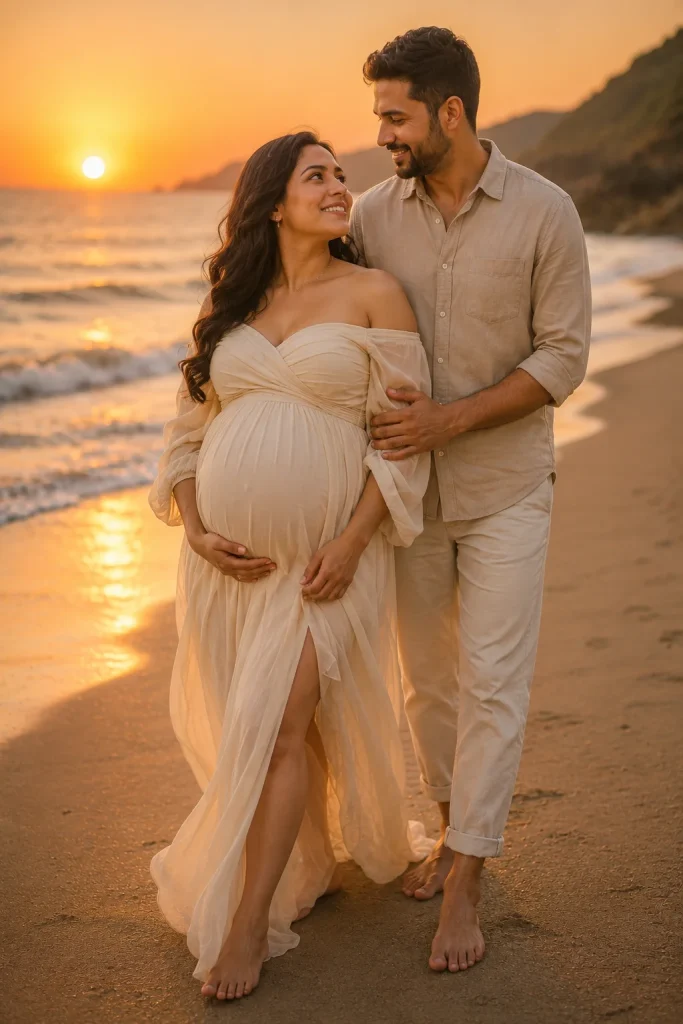
8. Partner Walking Behind With an Arm Around the Waist
This variation creates a relaxed lifestyle image while keeping the couple physically connected. The expecting parent walks slightly in front while their partner stays close behind with one arm resting gently around the waist.
The partner should avoid pulling tightly or placing pressure on the bump. Their hand can rest at the side of the waist, just above the hip or lightly beneath the bump, depending on what feels most comfortable.
The couple can look forward, turn their faces slightly towards each other or share a quiet conversation while walking. This pose is especially effective when photographed from a three-quarter angle because it shows both movement and the shape of the baby bump.
Practical tip: Use continuous shooting or burst mode to capture several steps. The most natural photograph is often taken between poses rather than at the beginning of the movement.
Helpful photographer prompt: “Walk closely together, keep one arm around the waist and quietly talk to each other as you move.”
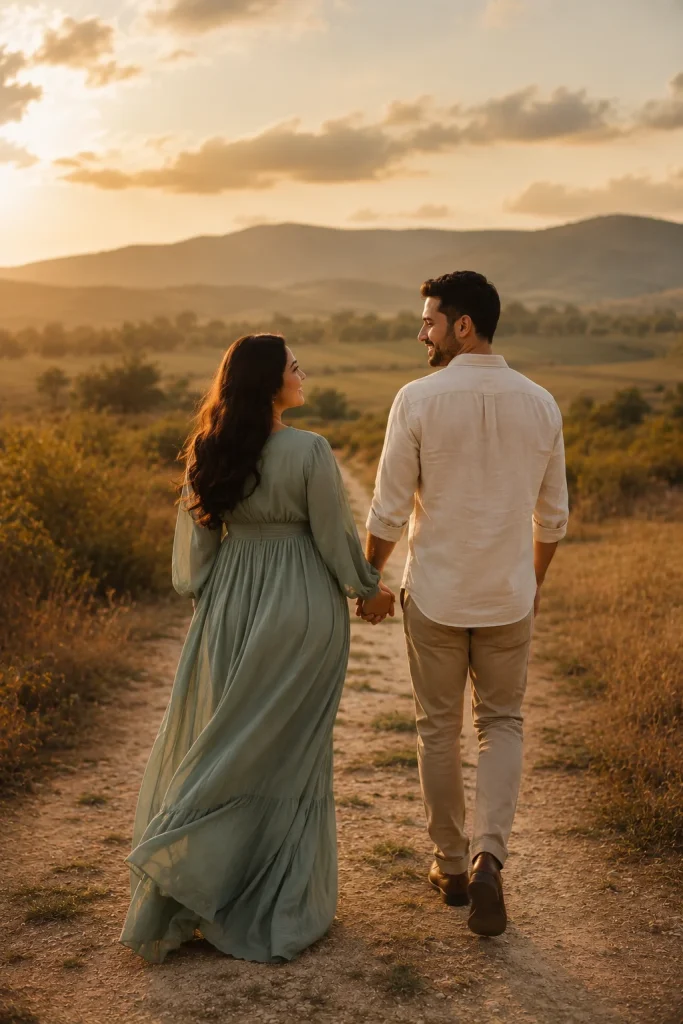
9. Walking Away From the Camera
A photograph taken from behind can highlight the location and give the image a documentary feel. It is a useful option for couples who feel self-conscious about facial expressions or direct posing.
The couple can walk hand in hand, place an arm around each other or move closely enough for their shoulders to touch. Turning slightly towards one another while walking keeps the image connected and prevents it from looking like a simple back-view photograph.
This pose works especially well on beaches, country paths, garden walkways and open landscapes. Flowing dresses and long skirts can add gentle movement to the composition.
Practical tip: Ask the couple to glance towards each other after a few steps. This small interaction adds warmth while preserving the candid appearance.
Helpful photographer prompt: “Walk away together, stay close and turn your heads slightly towards each other after a few steps.”
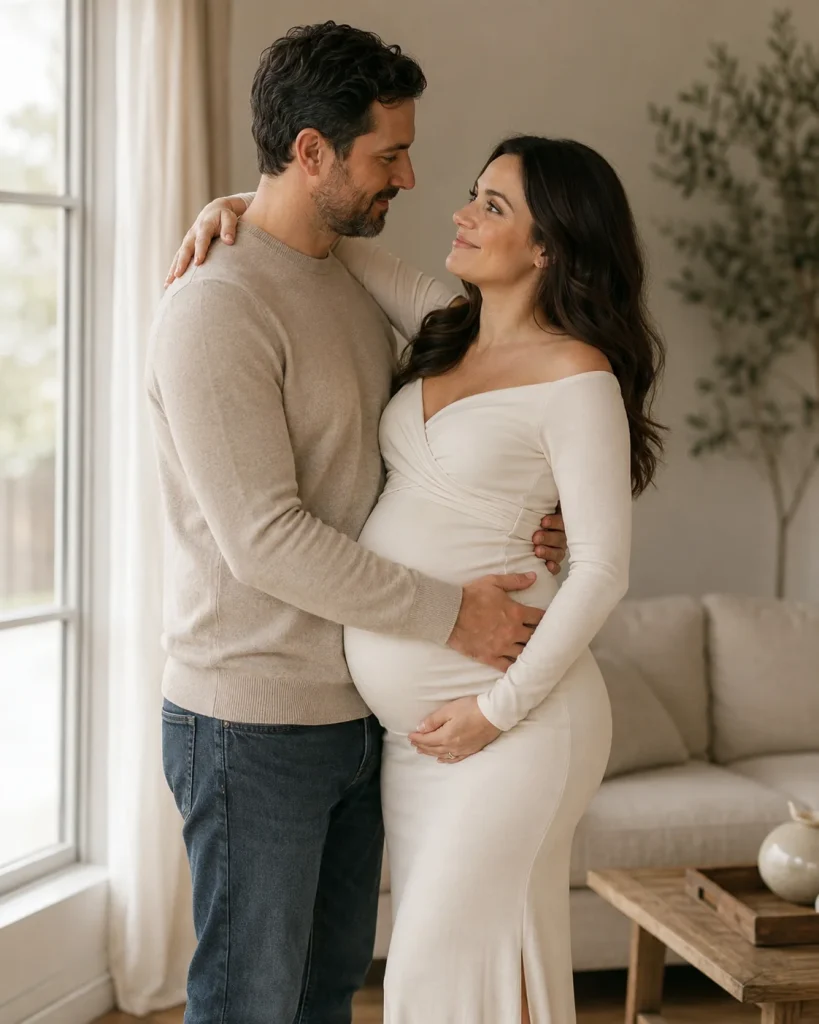
10. Slow Dance Pose
A slow dance creates soft movement without requiring the couple to walk through the location. It works beautifully in gardens, studios, living rooms, bedrooms and beach settings.
The couple does not need to perform a formal dance. Small swaying movements are usually enough. One partner can place a hand around the waist while the expecting parent rests a hand on the partner’s shoulder, chest or upper arm.
The couple can look at each other, close their eyes or laugh naturally as they move. The photographer can capture wide images showing the location, medium portraits showing the embrace and close-ups of hands and expressions.
Practical tip: Keep the movements small and comfortable. Large turns can feel awkward and may make it difficult to keep the bump visible.
Helpful photographer prompt: “Hold each other comfortably, sway from side to side and forget about the camera for a moment.”
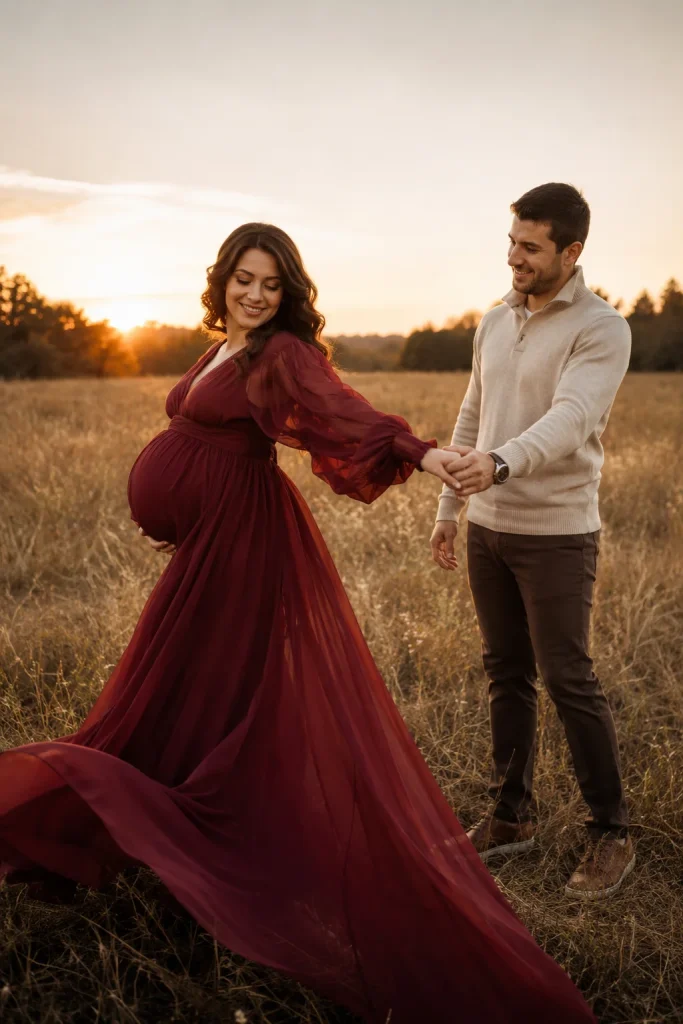
11. Spinning a Flowing Maternity Dress
A flowing maternity dress can add energy and visual movement to a couple portrait. Instead of asking the expecting parent to spin quickly, the partner can provide gentle support while the dress moves naturally around the legs.
The couple can hold hands while the expecting parent makes a small turn, or the partner can stand behind and lift a section of the dress lightly to create fabric movement. The pose should remain controlled and comfortable, particularly during the later stages of pregnancy.
This idea works best with lightweight fabrics such as chiffon, tulle or soft layered material. Open fields, beaches, gardens and spacious studios provide enough room for the fabric to move without becoming tangled.
Practical tip: Use a gentle half-turn instead of a full spin. The goal is to create movement in the dress while keeping the expecting parent steady and balanced.
Helpful photographer prompt: “Hold hands, make one slow half-turn and let the dress move naturally while your partner supports you.”
Movement-based photographs are most successful when the couple repeats each action several times. The photographer can then capture a mixture of wide environmental portraits, medium interactions and candid close-ups without forcing the couple to hold one position for too long.
Romantic Close-Up Maternity Photos
Close-up maternity photographs focus on the smaller details that can be missed in wider portraits. Hands resting on the bump, interlocked fingers and quiet facial expressions can communicate affection without requiring complicated posing.
These images also add variety to a maternity gallery. While full-length photographs show the couple’s clothing and location, close-up pictures preserve the emotional details of the pregnancy and the connection between both parents.
Close crops work particularly well for camera-shy couples because they do not always require both partners to look directly at the camera. The photographer can focus on hands, profiles or gentle interaction instead.
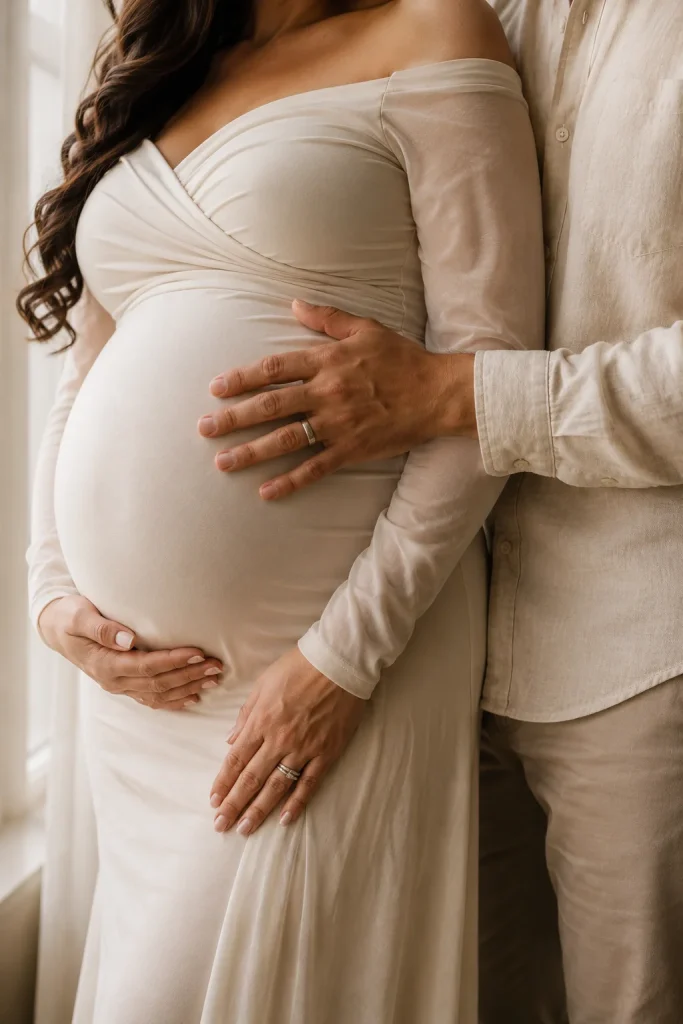
12. Both Hands Resting on the Bump
A close-up of both partners’ hands on the baby bump is one of the most recognisable couple maternity photographs. It places the pregnancy at the centre of the image while still showing both parents’ involvement.
The hands should be arranged naturally rather than stacked directly on top of each other. The expecting parent can place one hand underneath the bump while their partner rests one hand above it or gently around the side.
The photographer can crop the image from the shoulders to the hips or move closer to photograph only the bump and hands. Rings, clothing texture and soft fabric can add visual detail without requiring additional props.
Practical tip: Keep the fingers relaxed and slightly separated. Tense or perfectly straight fingers can make the pose look overly arranged.
Helpful photographer prompt: “Place one hand above the bump and one below it, then relax your fingers and gently lean into each other.”
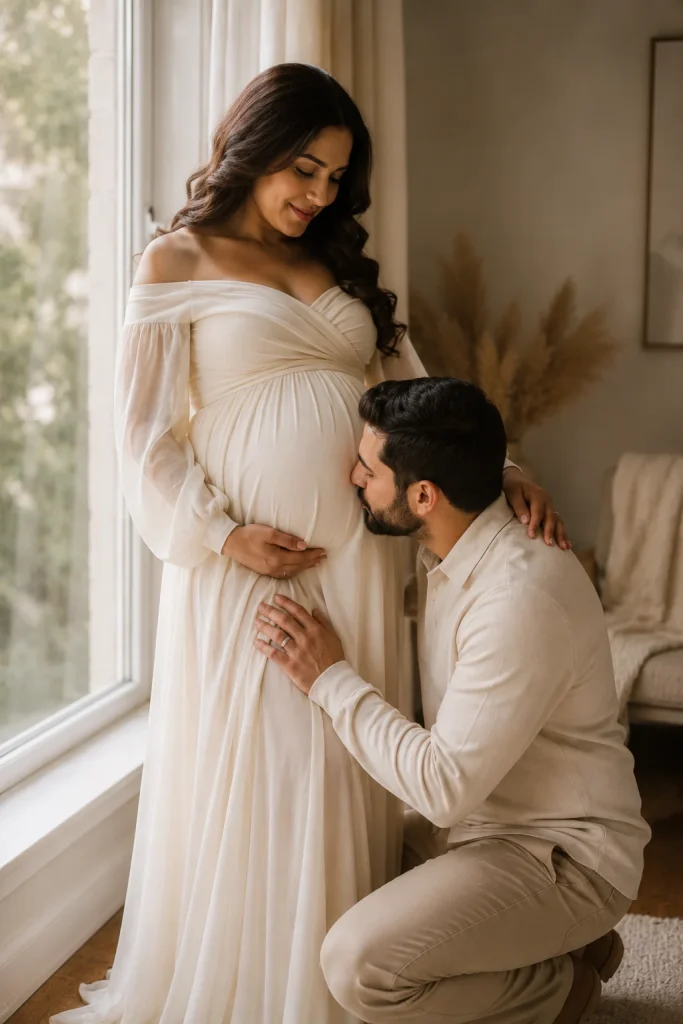
13. Partner Kissing the Baby Bump
A partner kissing the baby bump creates a tender photograph that clearly communicates anticipation and affection. It works especially well when the expecting parent is standing or sitting slightly sideways to the camera.
The partner can kneel, sit or bend gently towards the bump, depending on the setting and the expecting parent’s comfort. The expecting parent can look down at their partner, close their eyes or place one hand softly on their shoulder.
The photographer should include the expecting parent’s expression whenever possible. This helps the photograph feel like a shared interaction rather than only a picture of the partner kissing the bump.
Practical tip: Ask the partner to pause close to the bump before and after the kiss. These in-between moments may create a softer and more natural image.
Helpful photographer prompt: “Move close to the bump, pause for a moment and give one gentle kiss while your partner looks down at you.”
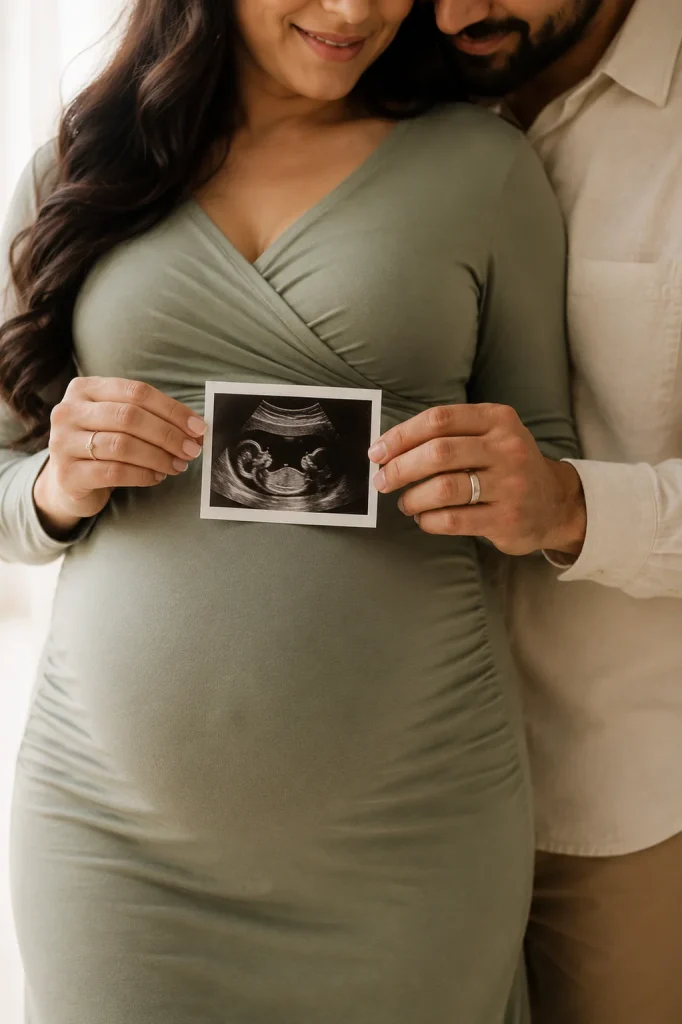
14. Couple Holding an Ultrasound Photo
An ultrasound image adds a meaningful personal detail to a couple maternity portrait. It can be used for a pregnancy announcement, a keepsake photograph or a quiet reminder of the baby before birth.
The couple can hold the ultrasound photograph together in front of the bump or position it slightly to one side so the shape of the pregnancy remains visible. Their hands should frame the image without covering the important details.
This pose works best with simple clothing and an uncluttered background. Too many additional props can compete with the ultrasound photograph and make the composition feel busy.
Practical tip: Keep the ultrasound image close to the bump to create a clear visual connection between the photograph and the pregnancy.
Helpful photographer prompt: “Hold the ultrasound picture together just above the bump and keep your fingers around the edges.”
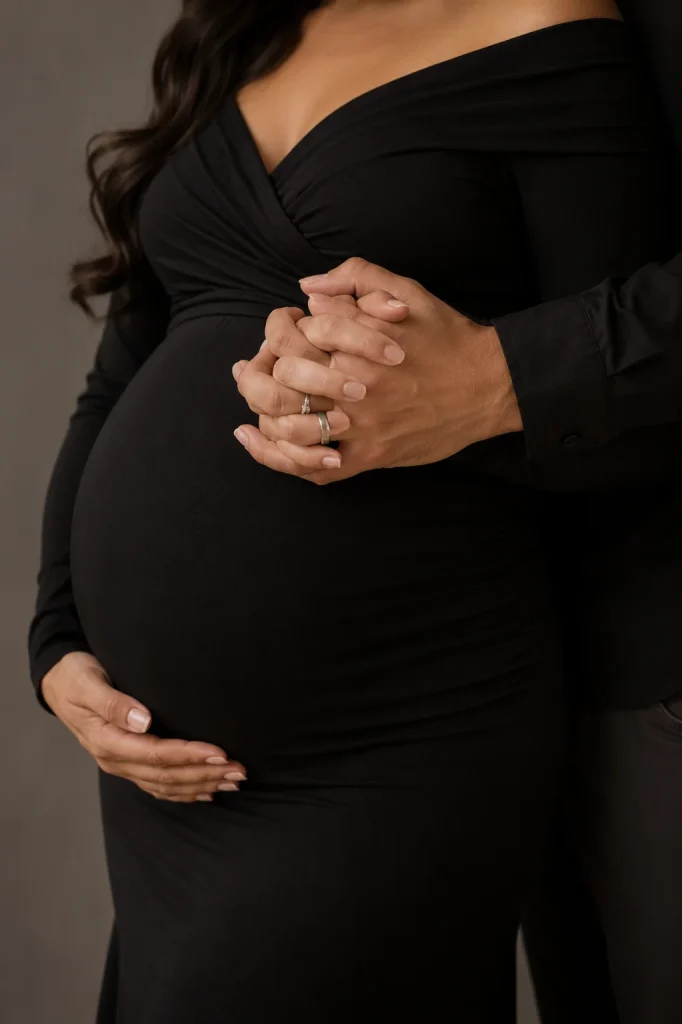
15. Close-Up of Interlocked Fingers Above the Bump
Interlocked fingers create a subtle close-up that represents partnership and support. It is less traditional than placing every hand directly on the bump and can feel especially elegant in a simple studio or at-home session.
The couple can join hands above the bump while the expecting parent places their free hand underneath it. Another option is for the partner to stand behind and gently hold the expecting parent’s hand across the upper part of the bump.
The photographer can focus closely on the fingers, rings and curve of the bump while allowing the couple’s clothing and bodies to blur softly into the background.
Practical tip: Ask the couple to loosen their grip. Fingers should be gently connected rather than tightly clasped.
Helpful photographer prompt: “Hold hands softly above the bump and let your fingers rest together without squeezing.”
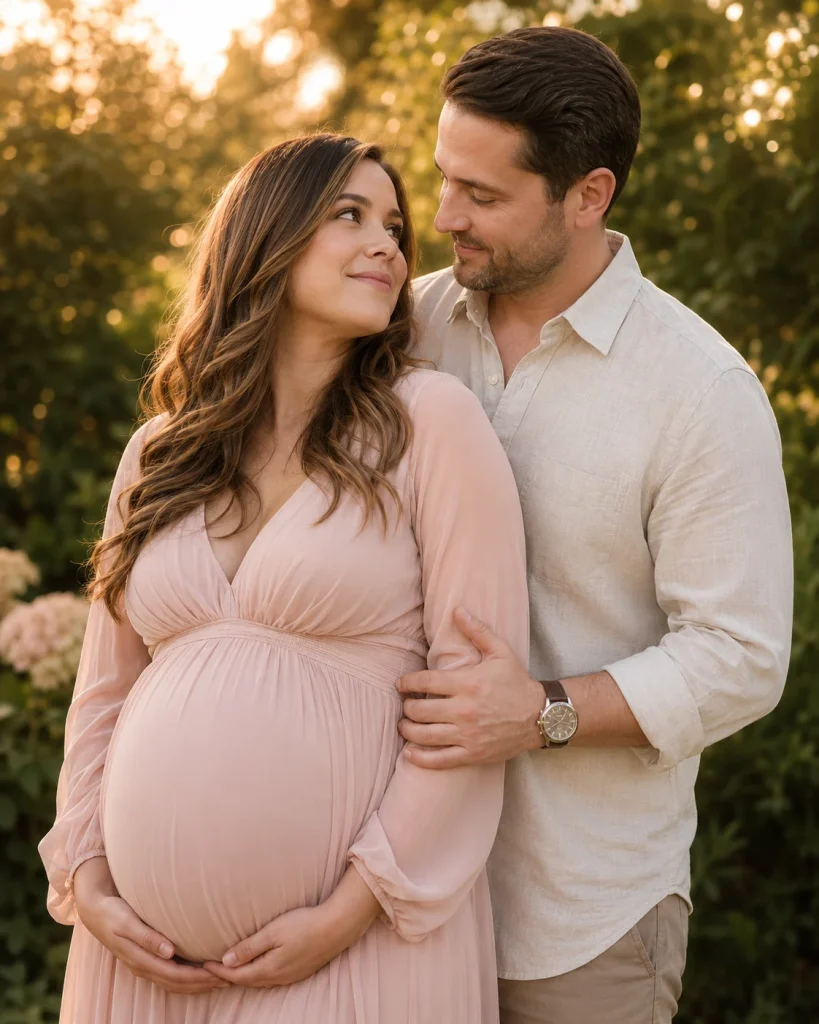
16. Faces Close Together With the Bump in Frame
This composition balances emotional connection with the pregnancy story. The couple brings their faces close together while the photographer keeps the baby bump visible in the lower part of the frame.
The expecting parent can stand slightly sideways while their partner leans in from behind or beside them. They can look at each other, close their eyes or share a quiet smile.
A three-quarter camera angle is usually more flattering than photographing both faces directly from the front. It also helps define the bump and prevents the couple from appearing flat against the background.
Practical tip: Keep the couple’s faces close but not pressed tightly together. A small amount of space around their profiles helps preserve the shape of both faces.
Helpful photographer prompt: “Bring your faces close, look softly at each other and keep one hand resting underneath the bump.”
When photographing close-up maternity poses, capture both horizontal and vertical versions where possible. Wider close-ups can show the couple’s expressions, while tighter crops can highlight hands, rings, fabric and the shape of the baby bump.
Seated Couple Maternity Photoshoot Ideas
Seated maternity poses can feel more relaxed than standing portraits, especially during the later stages of pregnancy. They allow the expecting parent to rest while creating close, connected compositions with their partner.
The main challenge is keeping the posture flattering and comfortable. Sitting too far back can hide the shape of the baby bump, while sitting completely upright may feel stiff. A slight angle, gentle support and careful hand placement usually create the most natural result.
Seated poses work well indoors and outdoors, including bedrooms, nurseries, gardens, beaches, parks and studio settings. They are also useful for couples who prefer quiet interaction instead of movement-based photographs.
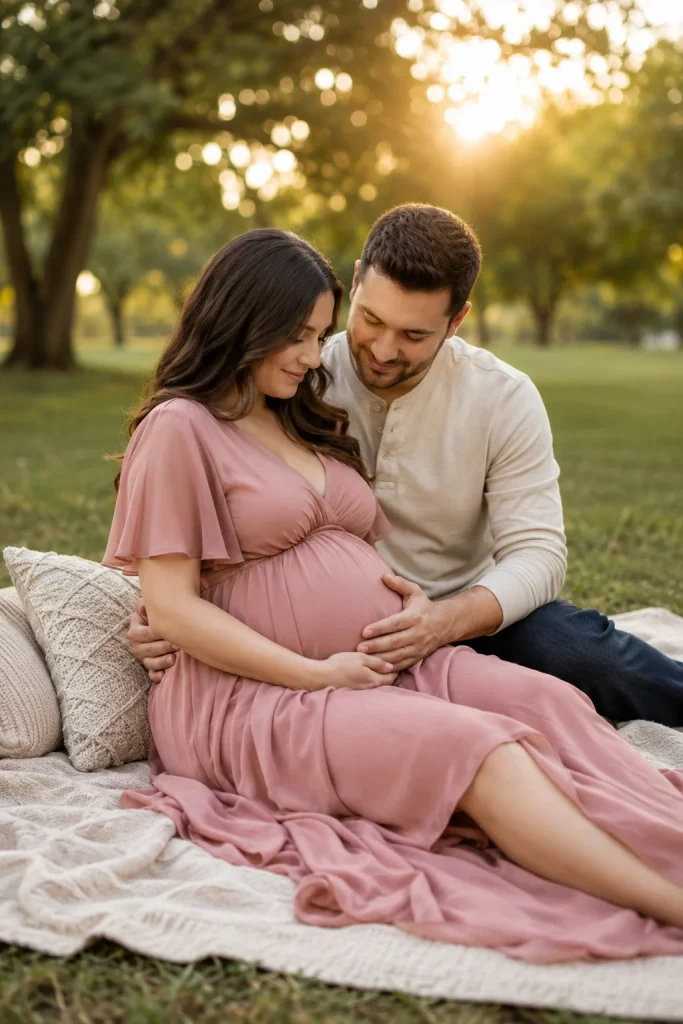
17. Sitting Together on a Blanket
Sitting together on a blanket creates a relaxed, lifestyle-style maternity photograph. It works particularly well in parks, gardens, fields and beach locations where the surrounding scenery can become part of the composition.
The expecting parent should sit at a slight angle rather than facing the camera directly. Their partner can sit closely beside them with one arm around the waist or one hand resting gently on the bump.
The couple can look at each other, look down at the baby bump or talk quietly while the photographer captures candid expressions. A folded blanket, small cushion or pillow can provide additional support and improve posture.
Practical tip: Avoid having both partners sit with their legs directly towards the camera. Angling the knees to one side creates a softer and more flattering body line.
Helpful photographer prompt: “Sit close together, angle your knees slightly away from the camera and look down at the baby together.”
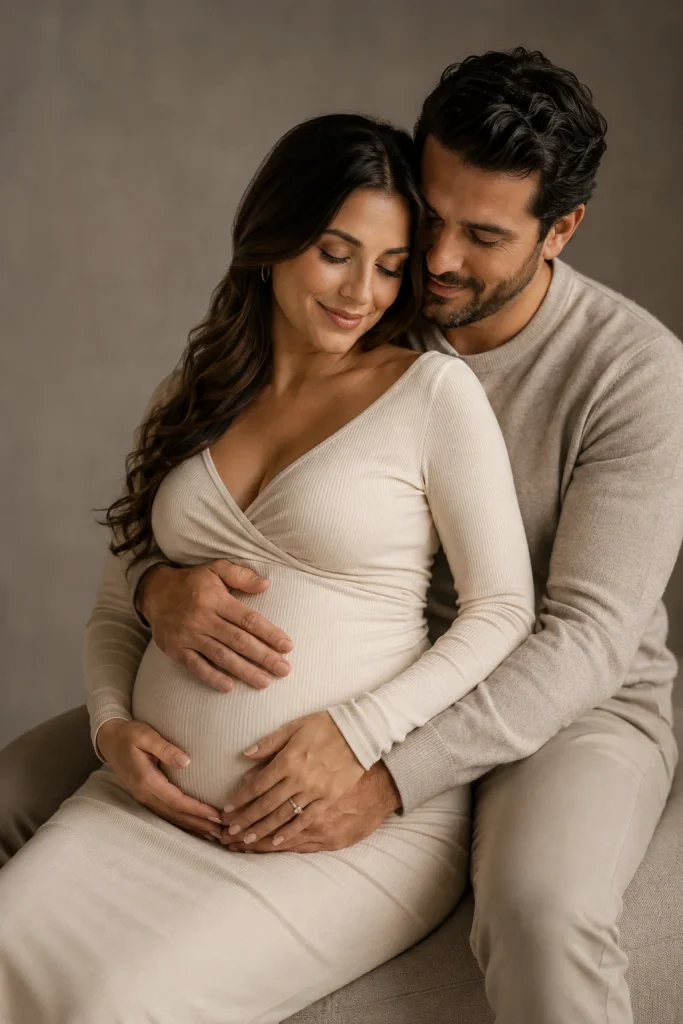
18. Partner Sitting Behind With Arms Around the Bump
This pose creates an intimate composition while allowing both partners to remain seated comfortably. The expecting parent sits slightly in front while their partner sits behind and gently wraps their arms around the waist or bump.
The partner can place one hand above the bump and another underneath it, while the expecting parent rests their hands softly over the partner’s hands. This keeps the pregnancy clearly visible and gives every hand a purposeful position.
To keep both faces visible, the partner should sit slightly higher or lean gently to one side. The expecting parent can look down at the bump, close their eyes or turn their face slightly towards their partner.
Practical tip: Position the couple at slightly different heights so one face does not become hidden behind the other.
Helpful photographer prompt: “Sit close behind, wrap your arms softly around the bump and bring your faces near each other without covering either profile.”
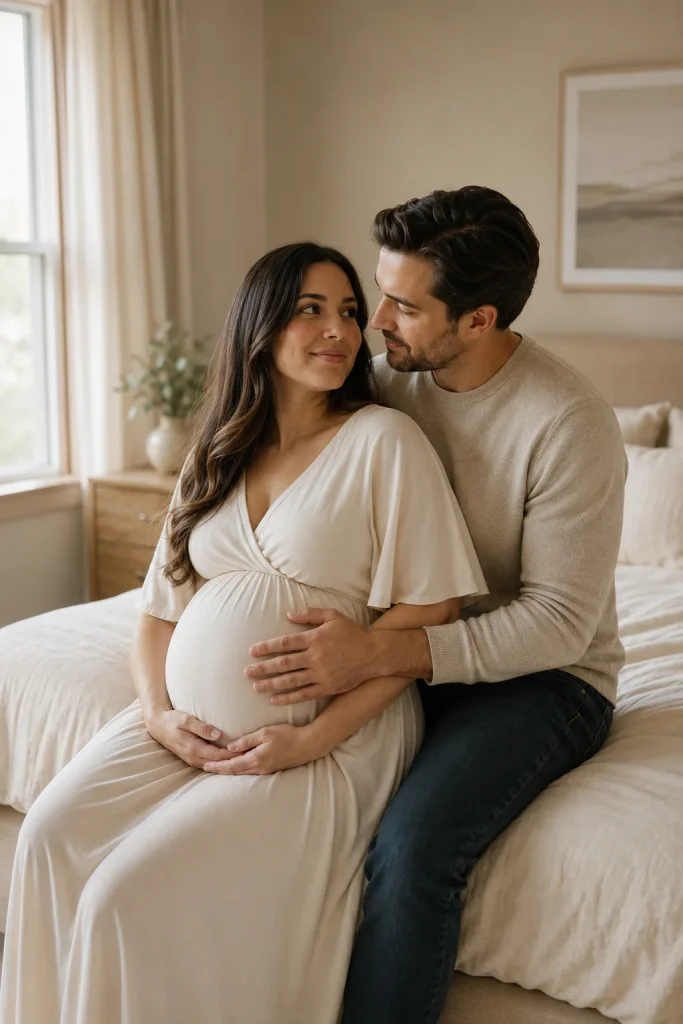
19. Sitting Together on the Edge of the Bed
An edge-of-the-bed pose is ideal for an at-home maternity session. It feels private, comfortable and emotionally personal without requiring a complicated setup.
The expecting parent can sit slightly sideways on the edge of the bed while their partner sits close beside them or slightly behind. One hand can rest underneath the bump while the partner places a hand around the waist, on the shoulder or gently above the bump.
Plain bedding and soft window light usually work best. Remove distracting objects from bedside tables, floors and the background so attention remains on the couple.
The photographer can capture full seated portraits, close-up hand details and quieter moments where the couple looks at the bump or talks naturally.
Practical tip: Ask the expecting parent to sit near the edge rather than far back on the mattress. This keeps the bump visible and prevents the posture from collapsing.
Helpful photographer prompt: “Sit close together near the edge, keep one hand under the bump and quietly look at each other.”
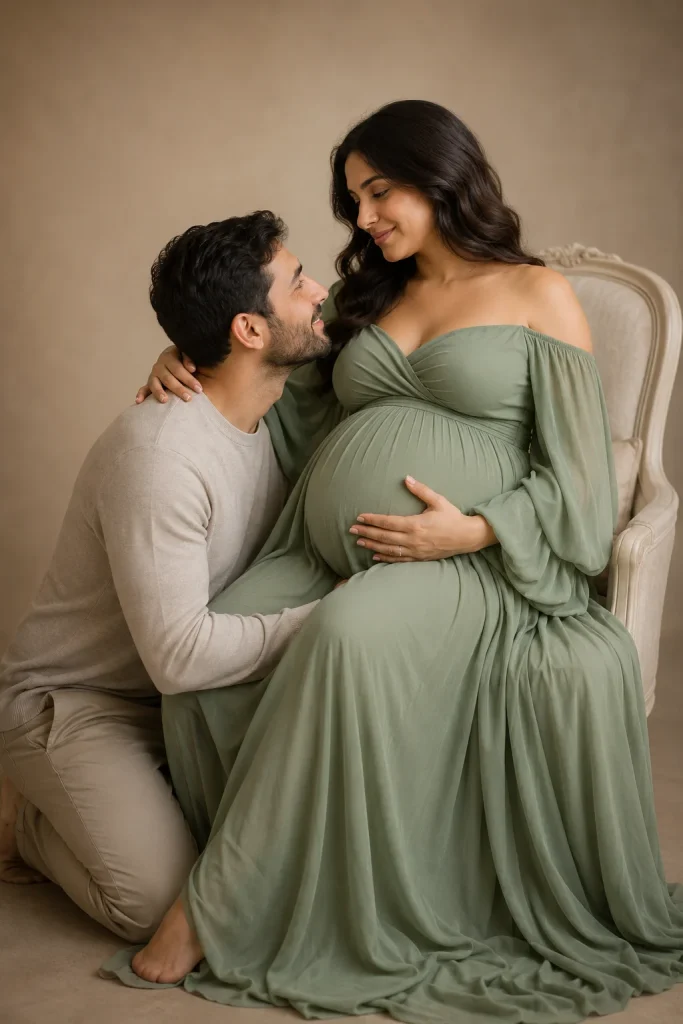
20. Partner Kneeling Beside the Expecting Parent
A kneeling pose creates different levels within the photograph and gives the partner a natural way to move closer to the baby bump. It works well when the expecting parent is seated on a chair, bench, bed or low stool.
The partner can kneel beside the expecting parent and place one hand gently on the bump while the other rests on their partner’s knee, waist or hand. The expecting parent can look down at them, touch their shoulder or softly hold their hand.
This pose can feel romantic, playful or emotional depending on the couple’s expressions. It is also a useful option for photographing a bump kiss while keeping the expecting parent’s face visible.
Practical tip: Keep the partner close to the chair or bed. Too much distance between them can create an empty gap and make the composition feel disconnected.
Helpful photographer prompt: “Kneel close beside your partner, place one hand softly on the bump and look up at each other.”
When using seated poses, comfort should always come first. Add cushions where needed, avoid holding one position for too long and allow the expecting parent to change posture between photographs.
Creative Couple Maternity Photos
Creative maternity photographs can make a couple’s gallery feel more personal and visually distinctive. Instead of relying only on traditional poses, these ideas use lighting, reflections, meaningful props and shared experiences to tell more of the couple’s story.
The strongest creative photographs still feel connected to the parents. A dramatic silhouette, for example, should clearly show the shape of the baby bump, while a meaningful activity should reflect something the couple genuinely enjoys rather than feeling like a staged scene created only for the camera.
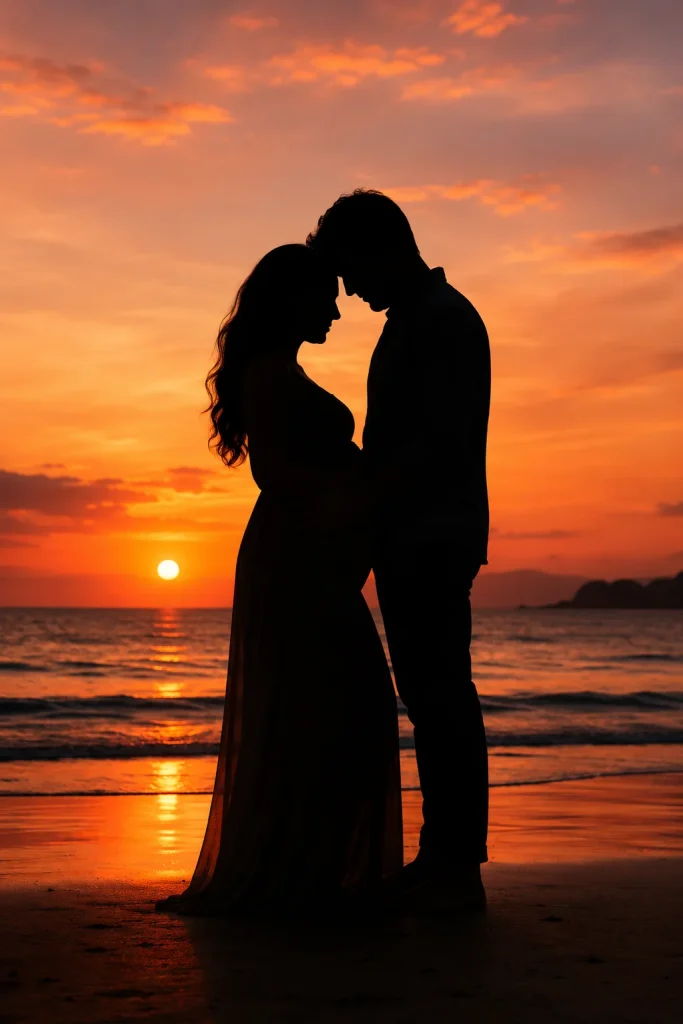
21. Sunset Silhouette
A sunset silhouette creates a dramatic outline of the couple and the baby bump. It works particularly well on beaches, hilltops, open fields and other locations with a clear view of the horizon.
The expecting parent should stand sideways to the light so the curve of the bump remains visible. Their partner can stand behind them, hold their hand, touch foreheads or lean towards the bump.
The photographer should expose for the bright sky rather than the couple. This darkens the figures while preserving the colours of the sunset and creating a clean outline.
Clothing should remain relatively simple. Flowing fabric can add movement, but too many overlapping layers may make the silhouette difficult to recognise.
Practical tip: Leave a small amount of space between the couple’s arms, faces and bodies. If every shape overlaps, the silhouette may appear as one solid form.
Helpful photographer prompt: “Turn sideways to the sunset, keep the bump clearly outlined and bring your foreheads close without completely overlapping.”
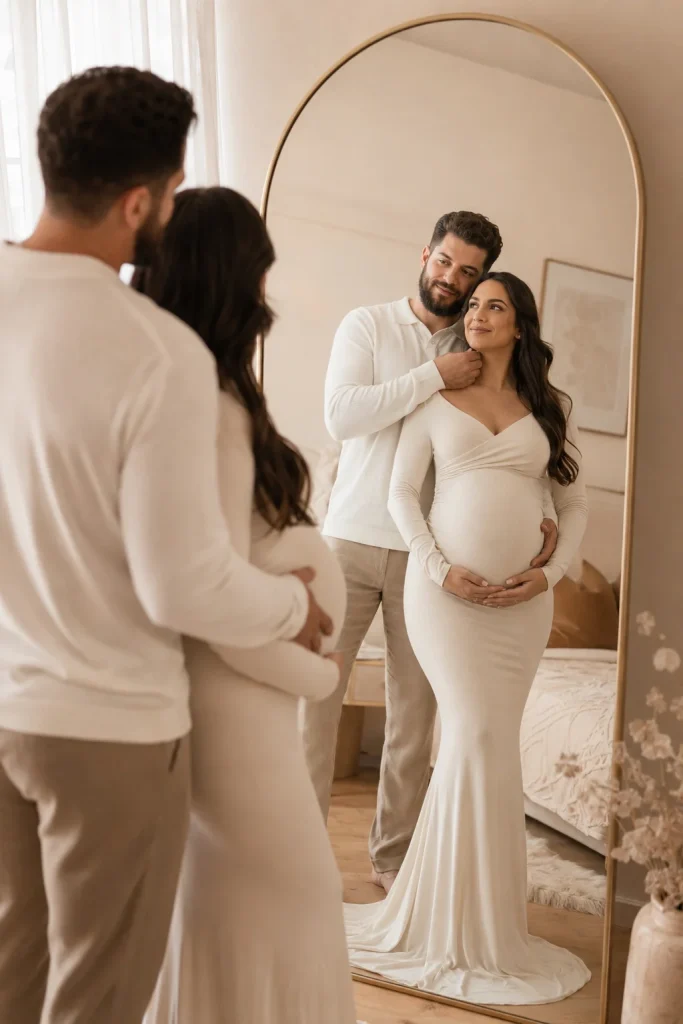
22. Reflection in a Mirror or Window
Using a mirror or window reflection can give a maternity portrait a more artistic and editorial appearance. It allows the photographer to show the couple from two perspectives or include both the room and their reflected interaction.
The couple can stand beside a large mirror while looking at the bump, embracing or adjusting each other’s clothing. A window reflection can also work well in a city, hotel or at-home setting.
Keep the surrounding space simple so the reflection remains the visual focus. Busy furniture, visible cables and unrelated objects may distract from the composition.
The photographer should also check the angle carefully to avoid appearing in the reflection unless that is part of the intended image.
Practical tip: Position the couple at a slight angle instead of directly facing the mirror. This helps show both their profiles and the shape of the baby bump.
Helpful photographer prompt: “Look at each other through the reflection, then slowly move one hand towards the baby bump.”
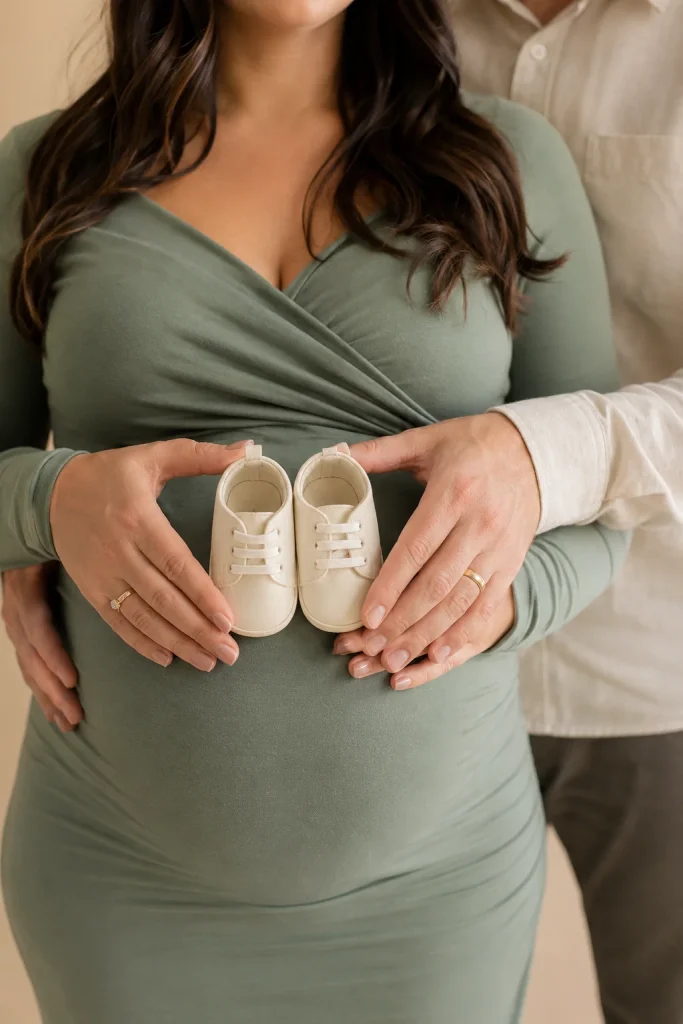
23. Matching Hands With Baby Shoes
Baby shoes create a simple symbolic photograph that represents the child joining the family. This idea works well for maternity announcements, social media photographs and close-up details within a larger gallery.
The couple can hold a small pair of baby shoes together in front of the bump or place them between their hands. Another option is for the expecting parent to support the shoes while their partner rests a hand gently above the bump.
Choose shoes with a clear, simple shape so they remain recognisable when the photograph is viewed at a smaller size. Neutral booties, tiny trainers or soft knitted shoes usually photograph well.
Practical tip: Avoid adding too many props around the baby shoes. A simple background and close crop will make the symbolism easier to understand.
Helpful photographer prompt: “Hold the baby shoes together directly in front of the bump and keep your fingers relaxed around the edges.”
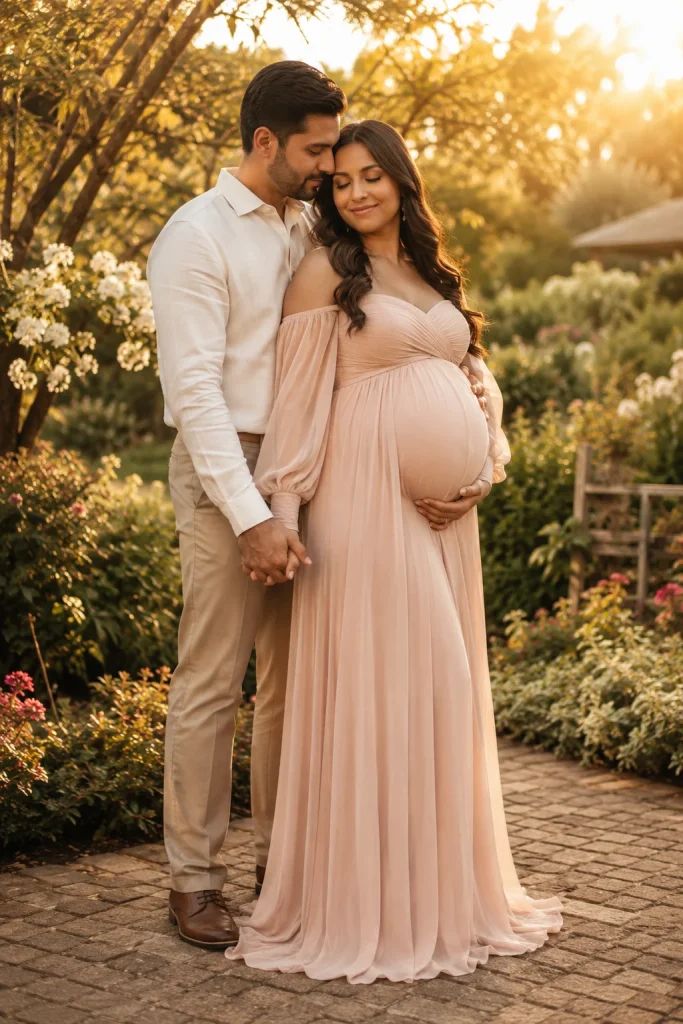
24. Recreating an Earlier Couple Photograph
Recreating an engagement, wedding, anniversary or travel photograph can show how the couple’s story has changed over time. The new image can match the original pose, location or composition while including the baby bump.
The recreation does not need to be exact. Matching the couple’s body language or returning to a meaningful location is often enough to make the connection recognisable.
For example, the couple could return to the place where they became engaged, stand in a pose similar to a wedding portrait or recreate a casual photograph from the beginning of their relationship.
If the original outfit is no longer suitable, choose colours or clothing styles that create a similar mood rather than forcing an uncomfortable match.
Practical tip: Bring the original photograph on a phone so the photographer can compare the angle, spacing and pose during the session.
Helpful photographer prompt: “Repeat the body position from your original photograph, but keep one hand naturally connected to the baby bump.”
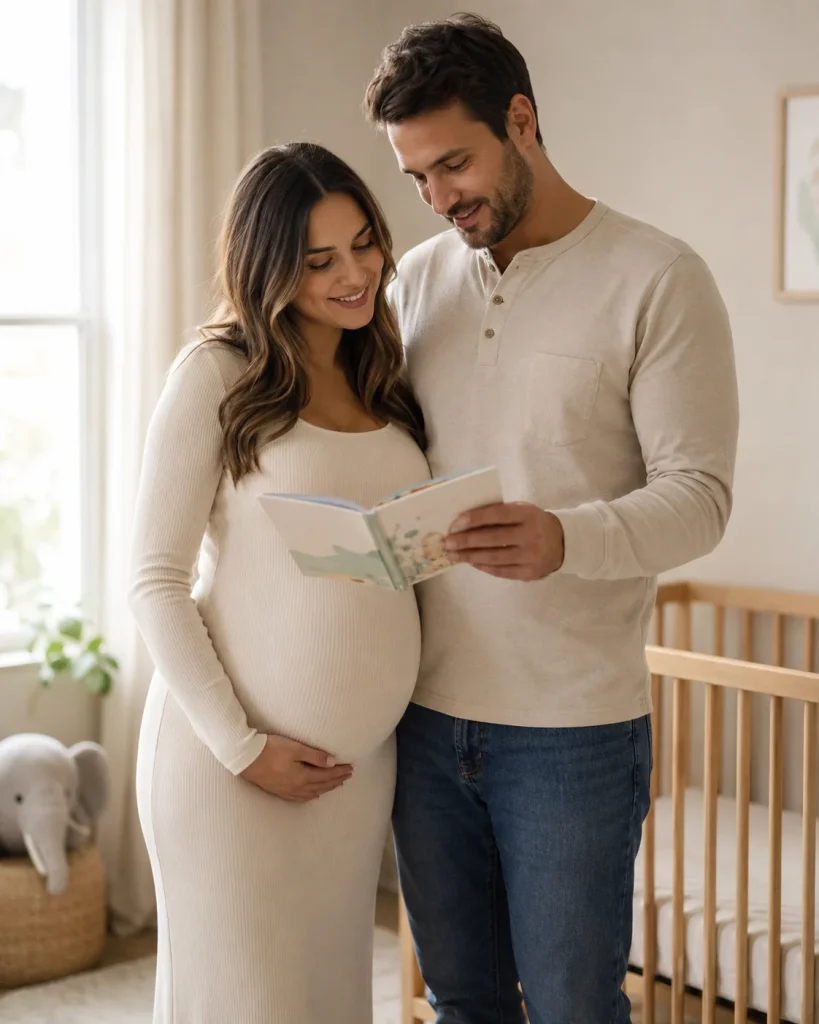
25. Including a Meaningful Shared Activity
A shared activity can make maternity photographs feel more like a genuine part of the couple’s life. Instead of standing in a formal pose, the parents can do something familiar while the photographer captures the interaction.
Meaningful activities might include reading a baby book, preparing the nursery, cooking together, walking a pet, sitting at a favourite café or visiting a location connected to the couple’s relationship.
The activity should remain simple enough for the pregnancy to stay visible. The photographer can alternate between wider images that show the environment and close-ups of hands, expressions and smaller details.
These sessions often produce the most natural expressions because the couple has something real to focus on. They can talk, laugh and move without constantly thinking about how they are posing.
Practical tip: Choose an activity the couple genuinely enjoys. Authentic familiarity will usually create stronger photographs than an elaborate idea chosen only because it looks attractive online.
Helpful photographer prompt: “Continue the activity naturally, talk to each other and occasionally pause to look down at the baby bump.”
Creative maternity photographs work best when they remain simple and meaningful. Choose one or two concepts that reflect the couple’s personality, then combine them with more traditional portraits for a balanced gallery.
How to Make Couple Maternity Photos Feel Natural
Natural couple maternity photographs are less about finding a perfect pose and more about creating genuine interaction. When couples are given something simple to do, they usually stop thinking about the camera and begin responding to each other more naturally.
Instead of holding one position for too long, combine gentle movement, clear hand placement and quiet prompts. These small actions can help both partners feel more comfortable and create photographs that reflect their real connection.
Focus on Interaction Instead of the Camera
Couples often become stiff when they are asked to stand still and smile directly at the camera. Looking at each other, talking quietly or focusing on the baby bump usually creates softer expressions.
Ask the couple to interact in ways that feel familiar. They might hold hands, adjust each other’s clothing, share a private joke or stand close while talking about the baby.
Useful actions include:
- Walking slowly together
- Talking quietly to each other
- Looking down at the baby bump
- Adjusting a sleeve, collar or loose strand of hair
- Sharing a private joke
- Holding hands naturally
- Leaning gently into each other
The photographer can still capture a few traditional portraits where both partners look at the camera, but these should be mixed with more relaxed interactions.
Keep the Hands Purposeful
Hands are one of the most common sources of awkwardness in couple maternity pictures. When a partner does not know where to place their hands, the pose may appear tense or disconnected.
Give each hand a clear but comfortable purpose. Good hand positions include:
- One hand above and one hand below the baby bump
- A hand resting gently around the waist
- Holding hands at the couple’s sides
- One hand resting on a shoulder
- A hand placed softly against the partner’s chest
- One hand underneath the bump for support
- An arm resting naturally around the partner’s back
Avoid leaving the hands hanging stiffly beside the body. Fingers should remain relaxed and slightly curved rather than pressed tightly against the bump or spread unnaturally.
Not every hand needs to touch the baby bump at the same time. Using different hand positions often creates a cleaner and more balanced composition.
Use Movement to Reduce Stiffness
Movement gives couples something to concentrate on besides posing. It can also create natural changes in posture, facial expressions and clothing.
Simple movement-based prompts include:
- Walk towards the camera slowly
- Walk away while holding hands
- Sway gently from side to side
- Take two steps and pause together
- Turn slightly towards each other
- Move closer for a forehead touch
- Adjust the maternity dress together
The movements should remain slow and comfortable. The goal is not to create dramatic action, but to introduce enough motion that the couple no longer feels frozen in place.
Give One Direction at a Time
Too many instructions can make a couple overthink the pose. Instead of asking them to change their hands, posture, expressions and head position simultaneously, give one clear direction at a time.
For example, begin by positioning their bodies. Next, adjust the hands. Finally, give them a simple interaction prompt such as looking at each other or taking a slow breath together.
This approach is especially helpful for a partner who feels uncomfortable in front of the camera. Clear, manageable instructions are easier to follow than technical posing language.
Use Prompts Instead of Asking for a Smile
Repeatedly asking a couple to smile can produce expressions that feel forced. Prompts encourage a genuine response and help each photograph feel slightly different.
Try prompts such as:
- “Walk towards me slowly and look at each other.”
- “Whisper something that will make your partner laugh.”
- “Sway together as though you are slow dancing.”
- “Take a deep breath and relax your shoulders.”
- “Look down at the baby together.”
- “Tell your partner what you are most excited about.”
- “Bring your faces close and close your eyes.”
These prompts should be suggestions rather than strict performances. Couples do not need to produce a large laugh or dramatic emotional response for the photograph to feel successful.
Avoid Forcing Expressions
Not every maternity photograph needs a wide smile. Soft expressions, closed eyes, quiet eye contact and thoughtful moments can feel just as meaningful.
Allow the couple’s natural personalities to guide the session. A playful couple may enjoy laughing and walking photographs, while a quieter couple may prefer gentle embraces and calm close-ups.
The photographs should reflect the relationship rather than imitate a pose that does not feel comfortable for them.
Photograph the Moments Between Poses
Some of the most natural images happen while the couple is moving into position, relaxing after a prompt or talking between photographs. These transitional moments often include genuine smiles, spontaneous touches and more comfortable body language.
The photographer should remain ready while the couple adjusts clothing, changes position or reacts to each other. These candid frames can become some of the strongest photographs in the final gallery.
Allow Time to Settle Into Each Pose
The first photograph in a pose may appear more formal because the couple is still thinking about the instructions. After a few seconds, shoulders relax, hands soften and expressions become more genuine.
Give the couple enough time to breathe and connect before moving to the next idea. Taking several variations of one pose is often more effective than quickly attempting many complicated setups.
Ultimately, the most natural couple maternity photos come from simple direction and authentic interaction. When couples are encouraged to move, talk and respond to each other, the photographs are more likely to feel personal rather than staged.
What Should Couples Wear for Maternity Photos?
The best couple maternity photoshoot outfits look coordinated without appearing identical. Rather than wearing exactly the same colours, choose two or three complementary shades that work well together and suit the location.
The expecting parent’s outfit will usually be the visual focus, especially when wearing a flowing maternity gown, fitted dress or textured fabric. The partner’s clothing should support that look without introducing competing patterns, large logos or overly bright colours.
Coordinate Rather Than Match Exactly
Matching outfits can sometimes make a couple look more formal than intended. A softer approach is to choose colours from the same palette.
For example, a blush maternity dress can be paired with cream, beige or soft grey clothing. A sage-green dress works well with tan, ivory or muted brown. These combinations create connection while allowing each person to maintain an individual style.
Try to limit the overall palette to two or three main colours. This keeps the photographs visually balanced and makes it easier to coordinate clothing with the setting.
Choose Solid Colours Where Possible
Solid colours are usually easier to photograph than bold prints, large graphics or visible logos. They keep attention on the couple’s expressions, body language and baby bump.
If one person wears a patterned outfit, the other should usually wear a solid colour taken from that pattern. For example, a floral maternity dress with soft blue details could be paired with a plain soft-blue or cream shirt.
Small, subtle patterns can work, but avoid combining multiple prints within the same portrait.
Let One Outfit Be the Main Focus
A flowing gown, fitted black dress or textured maternity outfit may naturally become the centre of the photograph. In that case, the partner should choose simpler clothing in a complementary shade.
This does not mean the partner must dress casually. A plain button-down shirt, knit jumper, linen shirt or tailored jacket can still look polished without competing with the maternity outfit.
If the expecting parent wears a simple outfit, the partner may add a subtle layer or texture, such as a neutral jacket or rolled-sleeve shirt, to create visual interest.
Avoid Large Logos and Distracting Details
Large logos, slogans and bold graphics can quickly date a photograph and pull attention away from the couple. Clothing with prominent brand names should generally be avoided.
Also check for distracting details such as bulky items in pockets, visible phone outlines, heavy keychains or uncomfortable belts. Removing these small distractions can make the final photographs look cleaner.
Consider the Location and Season
The outfits should feel appropriate for both the setting and the weather. Lightweight fabrics work well for beaches, gardens and warm outdoor locations, while knitwear, jackets and layered neutrals may suit autumn or winter sessions.
For a studio portrait, fitted dresses, tailored shirts and structured clothing often create an elegant look. At home, softer fabrics and comfortable neutral clothing can support a more relaxed lifestyle style.
Footwear should also match the location. Formal shoes may work in a studio or city setting, while clean boots, sandals or bare feet may feel more natural in a field, home or beach session.
Bring a Backup Option
A backup shirt, jacket or outer layer for the partner can quickly change the appearance of the photographs without requiring a complete outfit change.
It is also useful to bring an alternative in case the original clothing becomes creased, stained or uncomfortable. The expecting parent may want a second dress or a simpler outfit for seated and movement-based photographs.
Couple Maternity Outfit Colour Ideas
| Maternity Outfit | Partner Outfit | Overall Mood |
|---|---|---|
| Blush dress | Cream shirt with beige trousers | Soft and romantic |
| White gown | Soft blue or light-grey shirt | Clean and timeless |
| Black dress | Black, charcoal or crisp white clothing | Elegant and dramatic |
| Sage-green dress | Cream, tan or muted-brown clothing | Natural and earthy |
| Burgundy gown | Navy, charcoal or beige clothing | Rich and sophisticated |
| Floral dress | A solid colour taken from the print | Relaxed and seasonal |
Before the session, place both outfits next to each other and photograph them in natural light. This simple check can reveal whether the colours coordinate well or whether one item feels too bright, patterned or distracting.
For more detailed clothing inspiration, see our upcoming guide to pregnancy photoshoot outfit ideas for every style.
Best Locations for Couple Maternity Photos
The location of a couple maternity photoshoot influences the mood, clothing, lighting and types of poses that will work best. A beautiful setting can support the photographs, but it should not distract from the couple or make the session unnecessarily difficult.
Choose a location that matches the couple’s personality and comfort level. Some couples feel most relaxed at home, while others prefer an open beach, peaceful garden or polished studio environment.
Garden or Open Field
Gardens and open fields are ideal for soft, romantic maternity portraits. Natural greenery, flowers and open space create a gentle background without requiring many props.
These locations work particularly well for:
- Walking hand in hand
- Forehead-to-forehead poses
- Rear embraces
- Slow dancing
- Sitting together on a blanket
- Flowing maternity dresses
Golden hour, shortly after sunrise or before sunset, usually provides the most flattering outdoor light. Midday sunlight can create strong shadows, so look for open shade beneath trees or beside a building if the session takes place earlier.
Best for: Romantic, relaxed and nature-inspired photographs.
Beach
A beach provides open space, natural movement and a clean horizon. It is one of the strongest locations for walking photographs, silhouettes and flowing maternity gowns.
The couple can walk near the water, stand sideways against the sunset or sit together on a blanket above the tide line. Bare feet and lightweight clothing often feel more natural than formal footwear.
Wind can add beautiful movement to hair and fabric, but it may also make posing more difficult. Choose a calm time of day and bring clips or pins to manage loose clothing when necessary.
Best for: Walking poses, sunset silhouettes, playful movement and wide environmental portraits.
Home
An at-home maternity session can feel especially personal because it documents the couple within their everyday environment. Bedrooms, nurseries, living rooms and simple walls near windows can all become useful photo locations.
Home sessions work well for:
- Sitting together on the edge of the bed
- Reading a baby book
- Preparing the nursery
- Slow dancing in the living room
- Close-up photographs of hands and the bump
- Quiet, candid interactions
Before the session, remove unnecessary objects from the background and choose the room with the strongest natural light. Plain bedding, uncluttered furniture and soft neutral colours help keep attention on the couple.
Best for: Intimate, relaxed and emotionally personal maternity photographs.
Studio
A studio provides controlled lighting, privacy and a consistent background. It is a strong choice for couples who want elegant, polished maternity portraits without depending on the weather.
Simple studio backgrounds allow the photographer to focus on posture, clothing, hand placement and the shape of the baby bump. Fitted gowns, coordinated neutral outfits and black-and-white portraits work particularly well in this environment.
A studio is also convenient for outfit changes and seated poses because chairs, stools and privacy are usually available nearby.
Best for: Elegant portraits, dramatic lighting, fitted dresses and timeless photographs.
City or Architectural Location
A city location can give couple maternity pictures a modern, editorial feel. Quiet streets, stone buildings, cafés, hotel entrances and contemporary architecture can provide clean lines and visual structure.
These locations usually work best with more polished clothing, such as a fitted maternity dress, tailored shirt, long coat or structured neutral layers.
Walking poses and side-by-side portraits often feel more natural than highly romantic poses in a busy public area. Choose a quieter time of day to reduce crowds and distractions.
Best for: Modern, fashionable and editorial-style maternity portraits.
A Meaningful Location
A location connected to the couple’s relationship can make the photographs more personal. This might be where they became engaged, a favourite park, a familiar café, their wedding venue or a place they regularly visit together.
The setting does not need to be visually dramatic. Its emotional significance can give the photographs more value than a beautiful but unfamiliar location.
A meaningful place also gives the couple something natural to talk about, which may help them feel more relaxed during the session.
Best for: Storytelling photographs and couples who want their session to reflect their shared history.
How to Choose the Right Location
When comparing possible maternity photoshoot locations, consider:
- How far the expecting parent will need to walk
- Whether seating and toilets are available nearby
- The amount and direction of natural light
- Weather, temperature and wind conditions
- Privacy and the number of people likely to be present
- Whether permission or a photography fee is required
- How well the outfits suit the surroundings
- Whether the location allows several pose variations
Comfort should be prioritised over scenery. A simple location where the couple feels relaxed will usually produce stronger photographs than an impressive setting that requires difficult walking, uncomfortable weather or constant attention from other people.
Couples can also combine two nearby environments, such as a garden and a simple indoor space, to create variety without spending too much time travelling between locations.
For more setting-specific inspiration, this section can later link to our detailed guides to outdoor maternity photoshoot ideas, beach maternity photos and at-home pregnancy photoshoot ideas.
What to Bring to a Couple Maternity Photoshoot
Preparing a small maternity photoshoot bag can make the session more comfortable and prevent minor problems from interrupting the photographs. The goal is not to bring a large collection of props, but to pack a few practical items that support outfit changes, comfort and meaningful details.
Use the checklist below as a starting point, then adjust it according to the location, weather and style of the session.
Primary Outfits
Pack the main maternity outfit and the partner’s coordinated clothing carefully to reduce creasing. Use garment bags where possible and keep jewellery, belts or accessories in a separate pouch.
Check each outfit before leaving home for:
- Visible stains or marks
- Loose threads
- Missing buttons
- Wrinkles
- Uncomfortable seams or fastenings
If the expecting parent is wearing a long or flowing gown, transport it separately and change close to the photography location when possible.
A Backup Shirt or Layer for the Partner
A second shirt, jumper or jacket can quickly create a different look without requiring a complete outfit change. It is also useful if the original shirt becomes creased, stained or uncomfortable.
Choose a backup item that still coordinates with the maternity outfit. Neutral shades such as cream, beige, grey, soft blue or muted brown are usually easy to combine.
Comfortable Shoes
Even when formal shoes are part of the final outfit, bring a comfortable pair for walking between locations. Flat shoes, sandals or clean trainers can help reduce fatigue during outdoor sessions.
The expecting parent can change into the photography shoes only when needed. For beach or at-home sessions, barefoot photographs may also feel natural and comfortable.
Water and a Light Snack
Bring enough water for both partners, particularly during warm outdoor sessions. A small, simple snack can also be useful if the session lasts longer than expected.
Avoid foods that may melt, stain clothing or leave visible crumbs. Keep drinks away from gowns, props and photography equipment.
Hairbrush, Comb and Small Mirror
Wind, outfit changes and movement can affect hair throughout the session. A compact brush or comb allows for quick adjustments without taking too much time.
A small mirror can also help the couple check hair, makeup and clothing before close-up portraits.
Fashion Tape, Safety Pins and Hair Clips
Fashion tape and safety pins can help secure loose necklines, straps, fabric layers or clothing that shifts during movement. Hair clips are useful for managing wind between photographs, even if they are removed before the final image.
These items should be used carefully so they do not damage delicate maternity gowns.
An Ultrasound Image
An ultrasound photo can add a meaningful personal detail to the session. Keep it inside a protective envelope or firm folder so it does not bend during travel.
It can be held above the baby bump, framed between the couple’s hands or used in a close-up announcement photograph.
Baby Shoes or a Small Meaningful Prop
A small pair of baby shoes, knitted booties or another simple item can represent the baby without overwhelming the photograph.
Choose one or two meaningful props rather than bringing several unrelated objects. Simple items are usually easier to photograph and keep the focus on the couple.
Other suitable options may include:
- A baby storybook
- A small soft toy
- A meaningful piece of jewellery
- A handwritten note
- A family keepsake
An Outdoor Blanket
A clean blanket is useful for seated poses in parks, fields, gardens and beach locations. Choose a plain or lightly textured design that coordinates with the couple’s outfits.
Neutral colours such as cream, beige, soft grey or muted brown usually photograph well. Avoid large logos, bright graphics or busy patterns.
A Small Towel or Cloth
A small towel can be useful for wiping sand, damp grass, shoes or the edge of a maternity dress. It can also protect clothing while the couple moves between poses.
For beach sessions, consider bringing a second towel for feet after walking near the water.
A Phone Tripod and Remote Shutter for DIY Photos
Couples taking their own maternity photographs should bring a stable phone tripod and, if available, a remote shutter. These tools make it easier to take full-length portraits without repeatedly returning to the phone.
Test the timer, camera angle and remote before the session. Make sure the tripod is placed on level ground and remains stable in wind.
Weather-Specific Items
Outdoor sessions may require a few additional items depending on the season and location.
Consider packing:
- A warm coat to wear between photographs
- An umbrella
- Insect repellent
- Sunscreen
- A handheld fan
- A clear rain cover for personal items
- Clips for controlling a flowing dress in strong wind
Keep weather-related items out of sight during the photographs unless they are intentionally part of the session.
Quick Couple Maternity Photoshoot Checklist
- Primary maternity outfit
- Partner’s coordinated outfit
- Backup shirt or outer layer
- Comfortable walking shoes
- Photography shoes
- Water
- Light snack
- Hairbrush or comb
- Small mirror
- Fashion tape
- Safety pins
- Hair clips
- Ultrasound image
- Baby shoes
- One meaningful prop
- Outdoor blanket
- Small towel
- Phone tripod and remote shutter for DIY photos
- Weather-specific essentials
Pack everything the day before the session so there is time to replace missing items, steam clothing and confirm that the chosen props work well with the outfits. A simple, organised bag will make the experience feel calmer and help the couple focus on the photographs rather than last-minute problems.
Frequently Asked Questions
How should couples pose for maternity pictures?
Couples usually look most natural when their bodies are angled slightly towards each other instead of standing flat and facing the camera. The expecting parent should remain close enough to the camera for the baby bump to stay visible, while the partner can stand beside or slightly behind them.
Give each hand a clear purpose. Good options include placing one hand above the bump and another below it, holding hands, resting a hand around the waist or gently touching the partner’s shoulder or chest.
Simple interaction often works better than a complicated pose. Looking at the baby bump, touching foreheads, walking slowly or sharing a quiet conversation can create affectionate photographs without making the couple feel overly staged.
What should a partner wear to a maternity photoshoot?
The partner’s outfit should coordinate with the maternity outfit without matching it exactly. Choose solid colours from the same palette and avoid large logos, bold graphics or patterns that compete for attention.
For example, a blush maternity dress can be paired with a cream shirt and beige trousers, while a sage-green dress works well with tan, ivory or muted-brown clothing.
The partner should also choose clothing that feels comfortable and familiar. A well-fitting plain shirt, knit jumper, linen shirt or simple jacket can look polished while still allowing natural movement.
How can we avoid looking awkward in maternity photos?
Use movement and interaction instead of trying to hold a perfect pose. Walking hand in hand, swaying together, adjusting each other’s clothing or talking quietly can help both partners relax.
Photographers should give one instruction at a time and avoid repeatedly asking for a large smile. Softer expressions, closed eyes and quiet eye contact can feel just as emotional.
It also helps to begin with easy poses, such as walking, a rear embrace or both partners looking down at the baby bump. Confidence usually increases as the session continues.
Can couple maternity photos be taken at home?
Yes. An at-home maternity session can feel private, relaxed and highly personal. Bedrooms, nurseries, living rooms and simple walls near a window can all work well.
Useful at-home ideas include sitting together on the edge of the bed, slow dancing in the living room, reading a baby book or preparing the nursery together.
Choose the room with the strongest natural light and remove distracting objects from the background. Plain bedding, uncluttered furniture and neutral colours usually create the cleanest photographs.
Should the partner be included in every maternity photo?
No. A balanced maternity gallery can include solo portraits, couple photographs and close-up detail images.
Solo photographs allow the expecting parent, maternity outfit and baby bump to become the main focus. Couple portraits document the parents’ relationship, while detail images can capture hands, rings, ultrasound photographs and baby shoes.
The exact balance depends on personal preference, but including several different types of images usually creates a more complete gallery.
What are the best outdoor couple maternity poses?
Walking hand in hand is one of the easiest outdoor poses because it creates natural movement and relaxed expressions. Rear embraces, forehead touches and side-by-side portraits also work well in gardens, parks and open fields.
For seated photographs, the couple can sit together on a blanket at a slight angle. At sunset, a sideways silhouette can clearly show the shape of the baby bump while creating a more dramatic image.
The best pose will also depend on the location. Beaches are ideal for walking and silhouettes, while gardens and fields suit flowing dresses, gentle embraces and slow-dance poses.
Can we take couple maternity photos with a phone?
Yes. Modern phones can produce beautiful maternity photographs when used with good natural light and a stable camera position.
Place the phone on a sturdy tripod and use the timer, a remote shutter or a compatible smartwatch to take the photographs. Clean the camera lens before beginning and use the rear camera when possible because it usually provides better image quality.
Photograph near a large window indoors or during the softer outdoor light shortly after sunrise or before sunset. Avoid using strong digital zoom, and leave enough space around the couple so the image can be cropped later.
For DIY photographs, begin with simple poses such as standing side by side, holding hands, using a rear embrace or looking down at the baby bump. Take several versions of each pose so you can choose the most natural expression and hand placement.
Final Thoughts on Couple Maternity Photos
The most meaningful couple maternity photographs are not always the most complicated. Natural interaction, thoughtful hand placement and a comfortable setting usually matter more than creating a perfectly staged pose.
Choose ideas that reflect the couple’s real relationship. Some couples may feel most comfortable walking, laughing and talking, while others may prefer quiet forehead touches, close-up details or simple portraits focused on the baby bump.
Not every photograph needs to feel intensely romantic. A complete gallery can include playful movement, calm expressions, elegant portraits and candid moments between poses.
Try to capture a mixture of:
- Wide portraits that show the location
- Full-length photographs that include the outfits
- Medium portraits focused on the couple’s connection
- Close-ups of hands, faces and the baby bump
- Candid movement and natural interaction
Before the session, save your favourite couple maternity poses and choose three or four photographs that feel essential. Use those ideas as a starting point, then leave enough time for spontaneous moments to develop naturally.
The strongest photographs often happen when the couple stops thinking about the camera and simply focuses on each other and the baby they are preparing to welcome.
For more pose inspiration, outfit ideas and beautiful locations, explore our full collection of 51 pregnancy photoshoot ideas.